Who’s responsible for your file
Your file is handled by Abid, Certified QuickBooks ProAdvisor — the same person through the review, the corrections and the hand-back.
About AbidQuickBooks uncategorized expense cleanup
Empty the pile the file has been postponing.
A QuickBooks uncategorized expense cleanup empties Ask My Accountant and the Uncategorized Income and Expense accounts, so your profit and loss reports what the business actually spent. The work is done in review passes over patterns, not one transaction at a time, and the decisions only you can make come back as a short list.
A QuickBooks uncategorized expense cleanup is the work of emptying the holding accounts a file has been parking decisions in — Ask My Accountant, Uncategorized Expense, Uncategorized Income — and putting each transaction into an account that describes what the money actually was.
Those accounts exist for a reason. Ask My Accountant is meant to be a short queue for transactions nobody could classify at the time, emptied at each close. The Uncategorized accounts are where QuickBooks puts bank-feed activity that was accepted without a category being chosen. Neither is a problem in itself; the problem is when they stop being a queue and become the default. At that point the profit and loss reports one large line that answers no question anyone would ask of it, and the size of that line is the honest measure of how far the file has drifted. This is one piece of a full QuickBooks cleanup, not a substitute for reconciling the bank.
Files arrive here from a handful of recognisable routes, and all of them share one symptom: a holding account with a balance that has not been emptied in a long time.
The most common is a bank feed accepted at speed. Transactions were confirmed month after month without a category being picked, and QuickBooks did exactly what it is designed to do — parked them in its default account and waited. Close behind is the file where a bookkeeper used Ask My Accountant honestly, as a queue, and then left before the queue was worked. Others arrive after a year of catching up in a hurry, where getting transactions entered mattered more than classifying them, or after a migration that brought balances across without the detail behind them. A tax preparer asking what a five-figure uncategorized balance represents is often the moment a firm calls.
The work runs in review passes over groups of transactions rather than one transaction at a time, because the same decision usually answers dozens of them at once.
Three passes over the pile
A three-pass flow. Pass one groups the holding-account transactions by vendor and pattern rather than handling them singly. Pass two categorizes every group the records already answer. Pass three returns a short list of decisions only the owner can make, and each answer applies to a whole group. A confirmed panel shows the holding accounts emptied. Illustrative, not a real file.
The first pass groups the holding-account balance by vendor, amount pattern and recurrence, which usually collapses hundreds of transactions into a few dozen groups. The second pass categorizes every group the records already answer — a named vendor with an obvious purpose, a recurring subscription, a fuel card. The third pass produces the short list of decisions only the business can make: which of two similar vendors this was, whether a recurring unlabelled transfer is a draw or a real cost, whether a large one-off was equipment or repair. You answer once per group and the answer applies to everything inside it.
A file with nothing left in its holding accounts can still misreport the business, because categorization is a judgment applied to whatever data happened to be there.
Two failures hide behind a tidy-looking profit and loss. The first is categorizing into a chart of accounts that is itself broken — duplicate accounts holding the same kind of cost under two names, or accounts used for two different purposes — so the categories are precise and still wrong. Where that is the underlying problem, a chart of accounts cleanup comes first and this work sits on top of it. The second is categorizing transactions that should not have been expenses at all: personal spending run through the business, a transfer between the company's own accounts, or a payment that duplicates a bill already entered. Forcing those into an expense account produces a clean-looking report that overstates costs. Sorting them out is why the pile gets grouped before it gets categorized.
Timeline
Most run about a week: a day-0 review to size the pile, a few days working it in passes, a round of questions back to you, and a handback. Years of accumulation or mixed personal spending run one to two weeks.
Day 0
View-only look at the file; we measure the holding-account balances and how far back they run, then quote a fixed fee.
Days 1–2
Transactions are grouped by vendor, pattern and recurrence, which collapses hundreds of items into a few dozen decisions.
Days 2–4
Every group the records already resolve is categorized and logged, with the reasoning recorded rather than assumed.
Days 4–5
A short list comes back to you — one question per group, not per transaction — and your answers are applied across each group.
Day 6
Holding accounts emptied, a profit and loss that reads like the business, a written record of every group, and a call to walk it through.
You get holding accounts emptied to the decisions you approved, a profit and loss whose categories describe the business, and a written record of how each group was treated and why.
Nothing is a black box. The record lists each group, the transactions in it, the account it went to, and whether that was resolved from the records or answered by you — so you, or your tax preparer, can audit any line without calling us to explain it. Where the patterns are stable enough to support it, bank rules go in so the same pile does not rebuild over the next year. If the wider file also needs reconciling or an accounts payable cleanup, we scope that separately rather than fold it in quietly.
What changes
A categorized file answers questions about where the money went; a parked one reports one large line that answers none. Here is how the two compare.
| Categorized | Parked in a holding account | |
|---|---|---|
| Profit and loss shows real categories | — | |
| Holding accounts empty at the close | — | |
| Personal spending separated from business | — | |
| Transfers not counted as expenses | — | |
| Every decision recorded with its reason | — | |
| Bank rules keep the pattern going | — | |
| Tax preparer can work from the report | — | |
| Verdict | A report you can act on | One line that explains nothing |
What it costs
Every cleanup is a fixed scope with a fixed fee, quoted after a free view-only review. The figures below are published starting floors; the review sets the real range for your file.
| Engagement | Typical range | Timeline | What's included |
|---|---|---|---|
| Uncategorized cleanup | From $1,500 | 1 week | Group, categorize and empty the holding accounts for one file, with the decision log. |
| Cleanup + bank rules | Custom fixed quote | 1–2 weeks | The cleanup plus rules built for the stable patterns so it does not rebuild. |
| Part of a full cleanup | Custom fixed quote | 2–4 weeks | Rolled into a complete cleanup when the chart of accounts or the bank also needs work. |
| Get your range after a free review | |||
Uncategorized cleanup
Cleanup + bank rules
Part of a full cleanup
Four situations decide how an uncategorized cleanup actually runs, and each one has a boundary we hold rather than a judgement we make for you.
Personal spending run through the business is not an expense and does not get categorized as one. It is grouped, surfaced as its own list, and recorded the way you and your tax preparer decide — usually as an owner draw. Forcing it into an expense account would overstate costs and understate what the owner took, which is the opposite of a cleanup.
Money moved between two accounts the business owns is not spending, and a holding account often has a lot of it. Each side has to be recognised as the same movement rather than counted as an expense on one side and income on the other. Where the matching side is missing entirely, that is a reconciliation problem and we flag it as one.
Categorizing a transaction inside a period you have already filed on can change a figure that a return was built from. Those are separated out, listed with their dates and amounts, and handed to you and your tax preparer to decide — we do not quietly recategorize a closed year to make a report look tidier.
Some transactions cannot be identified from any record that still exists. Those stay visible as a named remainder with what is known about them, rather than being swept into a plausible-looking category to empty the account. An honest small balance beats a tidy wrong one.
One firm does the work — the same specialist start to finish — and the questions come back to you once per pattern rather than as a spreadsheet of hundreds of line-by-line queries.
The method is grouping before deciding. Working a holding account transaction by transaction is how a cleanup turns into a month of back-and-forth; grouping first collapses the same pile into a few dozen real decisions and makes your part of the job short. Every group is logged with the account it went to and whether the records answered it or you did, so the reasoning survives us. Access stays minimal: view-only for the free review, QuickBooks' accountant access for the work itself, never your bank logins. And where the honest answer is that a transaction cannot be identified, it stays as a named remainder rather than being filed somewhere plausible.
Skip us when the pile is small enough to work yourself, or when the real problem is the chart of accounts rather than the categorization sitting on top of it.
A few dozen transactions you recognise on sight do not need a paid engagement — our QuickBooks cleanup checklist walks the process for free, and grouping by vendor works just as well when you do it. If your holding accounts are already empty at each close, there is nothing here to buy. And if the real complaint is that your profit and loss is unreadable even though everything is categorized, the problem is the chart of accounts, not the categorization — that is a different engagement and we will say so rather than sell you this one. We will tell you which case you are in during the free review, including when the answer is that you do not need us.
You do not have to take our word for it. Here is the evidence you can check — the deliverable you receive, the reference behind the method, and our response commitment.
Your file is handled by Abid, Certified QuickBooks ProAdvisor — the same person through the review, the corrections and the hand-back.
About Abid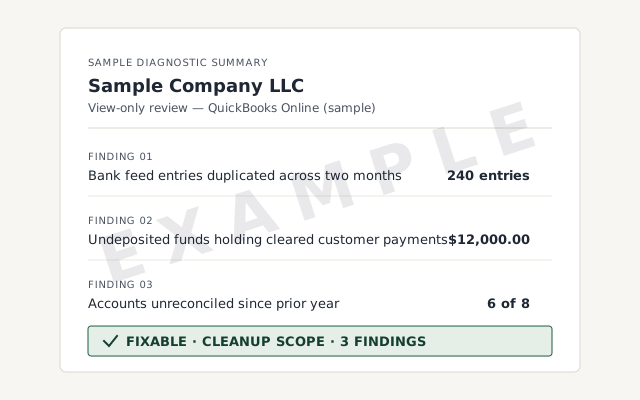 Sample workflow — not a specific client’s data
The record of each group, where it went, and whether the records or you answered it.
Categorization sits on top of the chart of accounts — read what a sound one looks like before you buy anything.
Read the chart of accounts referenceA written reply within one business day.
Remote-first, nationwide
Mon–Sat · 8am–6pm CT
We work entirely remote — view-only access for the free review, QuickBooks' accountant access for the cleanup itself, screen-share whenever you want to watch, and every categorization decision recorded in writing.
Ask My Accountant is a holding account for transactions nobody could categorize at the time they were entered. Used properly it is a short queue that gets emptied at the close. Used as a default, it becomes the place a file quietly parks every decision it did not want to make.
Usually because bank-feed transactions were accepted without a category being chosen, so QuickBooks posted them to its default holding account rather than to a real expense. Once that becomes the habit, months of spending land in one line that tells you nothing about where the money went.
It changes where the profit shows, and it can change the total. Money sitting in a holding account is already in your books, so moving it to a real expense account does not create new spending — but if some of that pile turns out to be an owner draw, a transfer, or a duplicate rather than an expense, correcting it moves the bottom line.
At a close, yes, or close to it. Between closes a handful of genuinely unresolved items can sit there waiting on an answer from you. What it should not do is carry a large balance month after month, because that balance is the measure of how many decisions the file has postponed.
Not on our own. We categorize what the records make obvious, group the rest into patterns rather than one-by-one questions, and bring you a short list of decisions only you can make — which vendor is which, what a recurring unlabelled payment actually was. You answer the pattern once and it applies to every transaction in it.
It gets separated, not categorized as business. Personal spending run through a business account is not an expense, and forcing it into one overstates costs and understates the owner's draw. We surface it as its own group and record it the way you and your tax preparer decide.
Where the patterns are stable, yes. Rules handle the repetitive calls — the same vendor, the same category, every month — which is what keeps the holding accounts empty after we hand back. Rules do not replace judgment on the transactions that are genuinely ambiguous, and we do not pretend otherwise.
Sometimes. Categorizing into a chart of accounts that has duplicate or misused accounts just produces precise-looking wrong answers, so where the chart is the underlying problem we say so and scope that first. Where the chart is sound and only the categorization drifted, this stands on its own.
Most run about a week: a day-0 review to size the pile, a few days working it in passes, a round of questions back to you, and a handback. Files with years of accumulation, or mixed personal and business spending, run one to two weeks.
Holding accounts emptied to the decisions you approved, a profit and loss whose categories reflect the business, a written record of how each group was treated, and — where the patterns support it — bank rules that keep it from rebuilding. If the wider file also needs work, we scope that separately.
An uncategorized pile rarely arrives alone: the chart of accounts cleanup underneath it, the bank feed problems that fed it, the accounts payable cleanup on the same books, or the full QuickBooks cleanup this can be part of.
Not sure how bad it is?
Describe the file and a specialist will tell you which of these you are dealing with — including when the answer is that you don't need us.