Who’s responsible for your file
Your file is handled by Abid, Certified QuickBooks ProAdvisor — the same person through the review, the corrections and the hand-back.
About AbidQuickBooks for veterinary practices
Veterinary medicine has a published chart of accounts. The AAHA/VMG standard, endorsed by the AVMA, sorts a practice into revenue centers with a cost of goods account paired to each, so pharmacy, food, retail and services can be read apart — and so your numbers can be compared with other practices at all.
QuickBooks for a veterinary practice means implementing a chart of accounts the profession has already written, rather than inventing one and losing the ability to compare yourself to anybody.
Most industries have no agreed account structure, so every business ends up with a chart shaped by whoever set it up, and comparisons across businesses are guesswork. Veterinary medicine is the exception. AAHA and the Veterinary Management Groups publish a standard chart of accounts, endorsed by bodies including the American Veterinary Medical Association, and it is the reason veterinary benchmarks exist in a usable form. That single fact drives most of what follows: the structure is not a matter of taste, and a clinic that adopts something adjacent to the standard rather than the standard itself gives up the benefit while doing the same amount of work. This page is one industry lens on a full QuickBooks cleanup, pointed at a clinic's books.
The structure that makes a veterinary practice readable is a set of revenue centers — professional services, pharmacy, prescription diet, over-the-counter product, laboratory, imaging, dentistry, boarding, grooming — with a cost of goods or supply account matched to each.
Four centers, four paired costs
Four revenue centers each shown with a paired cost account: professional services of 80,000.00 against surgical and medical supplies; pharmacy of 40,000.00 against pharmacy cost of goods of 12,000.00; prescription diet of 10,000.00 against diet cost of goods of 7,000.00; boarding of 15,000.00 against boarding supplies of 2,000.00. A confirmed panel notes that pooling all four into one income and one purchases account leaves a single blended margin. Illustrative figures, not a real practice.
The pairing is the whole point, and it is the part most often lost when a practice sets up its own chart. Revenue centers on their own produce a nicely detailed income statement and no margins, because every purchase still lands in one general account. A center matched to its cost tells you what that part of the practice actually returns: whether the pharmacy is carrying the clinic or the clinic is subsidising the pharmacy, whether diet sales are worth the shelf space and the working capital tied up in them, whether boarding covers its own staffing. Those are the questions practice owners ask, and a pooled file cannot answer any of them regardless of how carefully the income side was built.
Medication that goes home as part of treatment, prescription diet, and over-the-counter product on the shelf carry different margins and different buying patterns, and the standard keeps all three apart for that reason.
Dispensing follows caseload: it rises and falls with what walked through the door and what was treated. Diet follows a client relationship that can persist for years and behaves much more like a subscription than like a clinical service. Over-the-counter retail follows footfall and merchandising, and it competes directly with online sellers in a way clinical work does not. Merged into one product line, a practice sees a single number moving and has no way to attribute it — a decline in dispensing caused by a quiet quarter looks identical to clients moving their diet purchases online, and the responses to those two problems have nothing in common. Where the same physical item is sometimes dispensed and sometimes sold off the shelf, the split follows how it was actually sold rather than what it is, and that is a policy you set once and we then apply consistently rather than re-deciding month to month.
A clinic holding pharmacy stock, diet and retail product has a genuine inventory asset that must be valued and counted, and the chart of accounts alone does not make that true — the counting does.
A correct account structure tells you where inventory value and cost of goods belong; it cannot tell you whether the value recorded is real. That comes from counting, from receiving purchases against what was ordered, and from catching the difference between what the practice system says was sold and what the shelf actually holds. Clinics carry particular exposure here because product moves through several routes at once — dispensed at the counter, used in treatment without being sold, taken for a staff pet, expired and discarded — and only some of those generate a transaction anybody records. Where the recorded inventory has drifted from the physical shelf, the fix is a recount and a recost rather than a chart change, which is an inventory cleanup in its own right. Where the structure itself is wrong, that is a chart of accounts cleanup. Most clinics that come to us need the second before the first is worth doing.
The AAHA/VMG structure is detailed enough that a small clinic does not need every subaccount a large hospital uses, and the honest approach is to adopt the depth that fits and keep the definitions exact.
The failure to avoid is a near-miss: accounts that look like the standard, carry similar names, and quietly mean something else. A center defined slightly differently from the published definition breaks comparability entirely while giving every appearance of conforming, and the practice only discovers it when a benchmark comparison produces a result nobody can explain. Depth is negotiable; definitions are not. In practice that means starting from the standard rather than from your existing chart, mapping what you have into it, and accepting that some historical categories will not map cleanly and have to be decided rather than fudged. It is a one-time piece of work with a permanent payoff, and it is the single highest-value thing most veterinary files need. We scope how deep to go at the free review, and we will tell you when a two-person clinic does not need the full structure.
How it starts
Every engagement opens with a free, view-only review. For a clinic the review asks one question first: could you compare your numbers to a benchmark today, and would the comparison mean anything?
Day 0
We read the file view-only, compare your existing chart against the standard's definitions, and check whether any revenue center has a cost account paired to it.
Week 1
Existing accounts mapped into the AAHA/VMG structure at a depth that fits the practice, with anything that will not map cleanly decided rather than fudged.
Weeks 1–3
Prior periods reclassified into the centers and paired cost accounts where the records support it, so the first comparison has something to compare against.
Weeks 3–4
Revenue reconciled in summary against what the practice information management system reports, and inventory values agreed to a count.
Ongoing
Revenue posted by center, cost matched, the practice system reconciled, and a month-end package that reports margin per center rather than one total.
What changes
A clinic file built to the standard can be compared to the profession. A generic one produces numbers only that clinic can read, and only approximately.
| Built to the standard | Generic setup | |
|---|---|---|
| Accounts match the AAHA/VMG definitions | — | |
| Revenue grouped into centers | It depends | |
| Each center paired to its own cost account | — | |
| Dispensed, diet and retail kept apart | — | |
| Boarding and grooming on their own lines | — | |
| Inventory value agreed to a count | — | |
| Numbers comparable to industry benchmarks | — | |
| Verdict | Margin per center, comparable | One total, comparable to nothing |
What it costs
Every engagement is a fixed scope with a fixed fee, quoted after a free view-only review. The figures below are published starting floors; the review sets the real range for your file.
| Engagement | Typical range | Timeline | What's included |
|---|---|---|---|
| Veterinary cleanup | From $1,500 | 2–4 weeks | Map the chart to the AAHA/VMG standard, pair cost accounts to centers, reclassify history, agree inventory to a count. |
| Monthly bookkeeping | From $400/mo | Ongoing | Revenue posted by center, cost matched, practice system reconciled, month-end package with margin per center. |
| Multi-site or hospital | Custom fixed quote | Scoped first | More than one location, emergency or referral services, or the full standard at hospital depth. |
| Get your range after a free review | |||
Veterinary cleanup
Monthly bookkeeping
Multi-site or hospital
One firm does the work — the same specialist start to finish — and the chart is built to the published definitions rather than to something that resembles them.
The method is verification rather than assertion: revenue by center is reconciled against what the practice system reports and against the bank, and inventory value is agreed to a count rather than accepted from a balance nobody has tested. Where a historical transaction cannot be attributed to a center from the records available, it goes on a list for you instead of being allocated to whichever center makes a margin look plausible. We publish no benchmark figures of our own — the standard exists precisely so that comparisons come from the profession's data rather than from a bookkeeper's opinion, and we will not invent a target for your pharmacy margin. We do not claim what any particular practice information management system exports, because those change. And we stay clear of what is not ours: controlled substance obligations, clinical records and compliance questions go to your regulator, your CPA or your counsel. Access stays minimal — view-only for the free review, QuickBooks' accountant access for the work, never your bank logins.
Skip us when the practice is a mobile or house-call operation carrying almost no inventory, or when you have no interest in benchmarking.
A single-vet mobile practice that dispenses little and sells nothing has one revenue center and no meaningful cost of goods, so the structure this page is built on returns almost nothing — ordinary monthly bookkeeping serves you better and costs less. If comparing yourself to other practices is not something you intend to do, the main argument for adopting the standard falls away, and a simpler chart honestly built will serve you fine; we would rather say that than sell a mapping exercise you will never use. If the real problem is that your practice system and your shelf disagree, that is inventory counting and process, not a chart of accounts. And if your file is already on the standard with cost paired to each center, there is nothing here to buy. The free review will tell you which case you are in, including when the answer is that you do not need us.
You do not have to take our word for it. Here is the evidence you can check — the deliverable you receive, the reference behind the method, and our response commitment.
Your file is handled by Abid, Certified QuickBooks ProAdvisor — the same person through the review, the corrections and the hand-back.
About Abid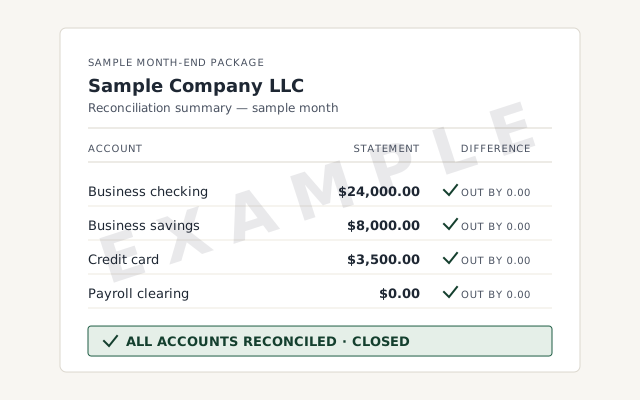 Sample workflow — not a specific client’s data
The margin-by-center summary and reconciliation a monthly clinic client receives.
Getting the account structure right before anything else is the whole discipline — read how we do it.
Read the chart of accounts methodA written reply within one business day.
Remote-first, nationwide
Mon–Sat · 8am–6pm CT
We work entirely remote — view-only access for the free review, QuickBooks' accountant access for the work itself, screen-share whenever you want to watch, and every mapped account and agreed inventory value recorded in writing.
It is a published standard for classifying revenue, expense and balance sheet accounts in small-animal veterinary practice, developed by AAHA and the Veterinary Management Groups and endorsed by bodies including the American Veterinary Medical Association. Unusually for an industry, veterinary medicine agreed on one account structure — which is why a vet practice can compare its numbers to its peers in a way most businesses simply cannot.
Because benchmarking only works if everyone counts the same way. If one practice books prescription diet inside general product sales and another gives it its own account, the two cannot be compared on anything that touches it, and any benchmark drawn across them is noise. Adopting the standard is what makes an outside comparison mean something, and it is the main reason to prefer it over a chart somebody invented for you.
A grouping of income by the part of the practice that earned it — professional services, pharmacy, prescription diet, over-the-counter product, laboratory, imaging, dentistry, boarding, grooming and so on. Each one carries its own economics. Pooled into a single income line, a practice cannot tell whether it is a clinic that also sells product or a retailer with a vet attached.
Because a revenue center without a matching cost account gives you a number you cannot read. Pharmacy revenue against pharmacy cost of goods is a margin; pharmacy revenue against a single pooled purchases account is just a total. The standard pairs them deliberately, which is what makes cost of goods reportable per center rather than as one figure covering everything the practice buys.
Dispensed medication goes home with a patient as part of treatment; over-the-counter product is sold off the shelf. They carry different margins and different buying patterns, so the standard separates them, and prescription diet is separated again from both. The same physical item can sometimes fall on either side, and where that happens the split follows how it was actually sold — a policy you set and we apply consistently.
No. They are separate services with their own staff, their own supplies and quite different economics from medicine, and the standard gives them their own revenue and supply accounts. A practice that pools them cannot answer whether boarding earns its space and its labour, which is usually the question that prompted the conversation in the first place.
The practice system is the record of what was done and sold; QuickBooks is the record of the money. Revenue detail is brought across in summary and reconciled — not re-keyed patient by patient — so the clinical and client-level detail stays where it belongs. Reconciling the two monthly is what keeps both credible, and it is the step most often missing when a practice cannot explain its own margins.
Not necessarily, and pretending otherwise would be selling you work. The standard is detailed, and a two-person clinic does not need every subaccount a twelve-doctor hospital uses. What matters is that the accounts you do adopt match the standard's definitions rather than being renamed approximations, because a near-miss on a definition breaks the comparability that was the whole reason to adopt it. We scope which depth fits your practice at the free review.
No. Controlled substance recording, DEA obligations and clinical records are governed by rules we do not interpret and are kept in your practice systems, not in the accounting file. We work with financial data — purchases, sales in summary, inventory values, payroll and the general ledger. Where a compliance question touches the books we point you to your regulator, your CPA or your counsel rather than answering it.
No. We keep the books — the revenue centers, the paired cost accounts, the inventory values, the monthly tie to the practice system — so the file is accurate and current. Your CPA sets tax positions, advises on inventory method and entity structure, and files returns. Good bookkeeping makes that work faster; it does not replace it.
A clinic that sells product has two problems at once: inventory cleanup handles the shelf, chart of accounts cleanup handles the structure, QuickBooks for dental practices covers the other clinic that reconciles to a practice system, and all industries lists the rest.
Not sure how bad it is?
Describe the file and a specialist will tell you which of these you are dealing with — including when the answer is that you don't need us.