Who’s responsible for your file
Your file is handled by Abid, Certified QuickBooks ProAdvisor — the same person through the review, the corrections and the hand-back.
About AbidQuickBooks for auto repair
A repair shop earns from four different things at once — labor, parts, sublet work and shop supplies — and each is priced differently and returns differently. Pooled into a single service revenue account, the file reports one blended gross margin that can look healthy while the parts side quietly erodes underneath it. Paired revenue and cost accounts are what make each line readable.
QuickBooks for a repair shop means building the file so that four different businesses running under one roof stop reporting as one number.
A ticket that reads $900 might be $400 of labor, $350 of parts, $120 of sublet alignment work and $30 of shop supplies. Those four amounts were priced by four different logics and cost four different things to deliver. A file that records the ticket as $900 of service revenue against whatever parts invoices happened to arrive that month has thrown away every question worth asking — which is why so many shop owners can describe their car count and their average ticket precisely but cannot say what their parts margin is. The structure is not complicated; it just has to exist before the transactions start landing. This page is one industry lens on a full QuickBooks cleanup, pointed at a shop's books.
The structure that makes a repair shop's books readable is a matched pair for each revenue stream: labor revenue against technician labor cost, parts revenue against parts cost, sublet revenue against sublet cost, and shop supplies charged against shop supplies cost.
One ticket, four paired lines
A repair ticket of 900.00 splits into labor of 400.00, parts of 350.00, sublet of 120.00 and shop supplies of 30.00. Each revenue line is paired with its own cost account: technician labor cost, parts cost, sublet cost and shop supplies cost. A confirmed panel notes that pooling all four into one service revenue account leaves a single blended margin that can look healthy while one line erodes. Illustrative figures, not a real shop.
The reason the pairing matters is that the four lines behave nothing alike. Labor is sold at a shop rate set against what a technician costs per hour, and its margin moves with efficiency and with wages. Parts are sold at a markup over supplier cost, and their margin moves with supplier pricing and with discipline at the counter. Sublet is bought and billed through, often at or near cost. Shop supplies are recovered as a percentage against a real but scattered spend. With four paired accounts, each of those has its own answer. With one pooled account, a shop can watch a healthy-looking combined margin for a year while parts pricing slips, because strong labor is quietly covering the gap.
Sublet is work sent out to a specialist — machine shop, glass, alignment, towing, upholstery — that you bill to the customer on your own ticket, and it needs its own paired revenue and cost accounts for exactly that reason.
The money passes through the shop rather than being earned by it, or is earned only to the extent of whatever margin is added. Booked into parts, it inflates parts revenue with something that carries no parts markup and drags the reported parts margin down. Booked into labor, it credits the shop with work no technician performed and distorts the one number that measures productivity. Given its own line on both sides, the specialist's invoice sits directly against the sublet you billed, and the margin on outsourced work becomes a number you can see and price against. How the customer sees it on the invoice — a service item at cost, or with a markup — is a pricing decision that is yours; where it lands in the accounts is the bookkeeping, and it should not vary by who entered the ticket. The same pass-through question drives a different industry entirely on our agency page, where a client's media budget raises it at much larger scale.
A core charge is a deposit on a returnable part, refunded when the old unit goes back to the supplier — and the weak point is not the entry, it is whether the promised credit ever actually arrives.
The core is charged, the part is fitted, the old unit is boxed and collected, and the credit is meant to appear on a later supplier statement. QuickBooks has no way to notice that it did not. There is no built-in mechanism that watches for a credit that was expected and never came, so an unreturned credit sits as real cost the shop already paid and quietly absorbed. Closing that loop is a discipline rather than a feature: cores tracked as open items until settled, supplier statements reconciled against the returns that earned the credits, and anything unresolved raised with the supplier while the paperwork still exists. The same applies to warranty parts and to returns generally. Where a shop stocks parts rather than ordering per job, the inventory side has its own failure modes, which is an inventory cleanup in its own right.
Not every repair shop needs inventory tracking, and turning it on where it is not earned adds counting work that returns nothing.
A shop that orders parts per job and fits them within the week is effectively running parts as a direct cost: the part arrives, goes on the car, and is invoiced. Full inventory tracking there means maintaining item records and counts for things that were never really held. A shop carrying fast-movers, filters, fluids, batteries and tires has a genuine asset sitting on the shelf that has to be valued, counted and reconciled, and running it as a direct cost misstates both the balance sheet and the month a cost belongs to. Most shops are somewhere between, stocking a short list and ordering the rest. The right answer is a scoped decision rather than a default, and it is one of the things a free review settles — including when the honest answer is that you should leave inventory off.
How it starts
Every engagement opens with a free, view-only review. For a shop, the review asks one question first: can the file tell you your parts margin without you working it out by hand?
Day 0
We read the file view-only and test whether the four revenue lines exist, whether each has a paired cost account, and how sublet and cores are currently landing.
Week 1
Labor, parts, sublet and shop supplies given their own revenue and cost accounts, and the ticket import or entry mapped to land in them.
Weeks 1–3
Prior revenue split back into its lines where the records support it, supplier bills matched to the jobs they belonged to, and sublet pulled out of parts and labor.
Weeks 3–4
Cores and returns reconciled against supplier statements, outstanding credits listed for you to chase, and everything tied to the bank.
Ongoing
Tickets landing split by line, supplier statements reconciled, and a month-end package that reports margin per revenue line rather than one blended figure.
What changes
A shop file built for the trade answers what each part of the business returns. A generic one gives you one margin and no way to explain it.
| Built for a shop | Generic setup | |
|---|---|---|
| Labor revenue paired to technician cost | — | |
| Parts revenue paired to parts cost | — | |
| Sublet on its own revenue and cost line | — | |
| Shop supplies charged vs. spent, visible | — | |
| Core charges tracked to settlement | — | |
| Inventory turned on only where it is earned | It depends | |
| Gross margin readable per line | — | |
| Verdict | Four answers you can act on | One number that explains nothing |
What it costs
Every engagement is a fixed scope with a fixed fee, quoted after a free view-only review. The figures below are published starting floors; the review sets the real range for your file.
| Engagement | Typical range | Timeline | What's included |
|---|---|---|---|
| Repair shop cleanup | From $1,500 | 2–4 weeks | Build the four paired lines, re-split historical revenue, pull sublet out, reconcile cores and supplier credits. |
| Monthly bookkeeping | From $400/mo | Ongoing | Tickets landing split by line, supplier statements reconciled, month-end package each period. |
| Multi-bay or multi-site | Custom fixed quote | Scoped first | More than one location, or a shop carrying real parts inventory that has to be valued and counted. |
| Get your range after a free review | |||
Repair shop cleanup
Monthly bookkeeping
Multi-bay or multi-site
One firm does the work — the same specialist start to finish — and the four revenue lines are rebuilt from the records rather than estimated into a split that makes the totals work.
The method is verification rather than assertion: supplier bills are matched to the jobs and the lines they actually belonged to, so a parts margin can be defended rather than assumed, and sublet is identified from the vendors that performed it rather than guessed from the amount. Where the records cannot establish which line a historical amount belonged to, it goes on a list for you instead of being allocated to whichever bucket balances. We do not claim what your shop management system exports, because those change and naming a feature is not the same as promising one — we work from what yours actually produces. And pricing decisions stay yours: your shop rate, your parts markup and your supply percentage are commercial calls, and our job is to show you what each is returning. Access stays minimal: view-only for the free review, QuickBooks' accountant access for the work, never your bank or supplier portal logins.
Skip us when you are a one-bay operation running labor only, or when what you actually need is a shop management system rather than a bookkeeper.
A mobile mechanic or a single-bay shop that bills labor and has the customer buy their own parts has one revenue line, not four — the mechanics on this page mostly do not apply, and straightforward monthly bookkeeping is enough. If the real problem is that you cannot write an estimate, track a job through the bays, order parts against a ticket or see technician hours, that is shop management software; QuickBooks reports the money afterwards and should not be asked to run the floor. And if your file already carries the four paired lines, keeps sublet separate and reconciles supplier credits, there is nothing here to buy. The free review will tell you which case you are in, including when the answer is that you do not need us.
You do not have to take our word for it. Here is the evidence you can check — the deliverable you receive, the reference behind the method, and our response commitment.
Your file is handled by Abid, Certified QuickBooks ProAdvisor — the same person through the review, the corrections and the hand-back.
About Abid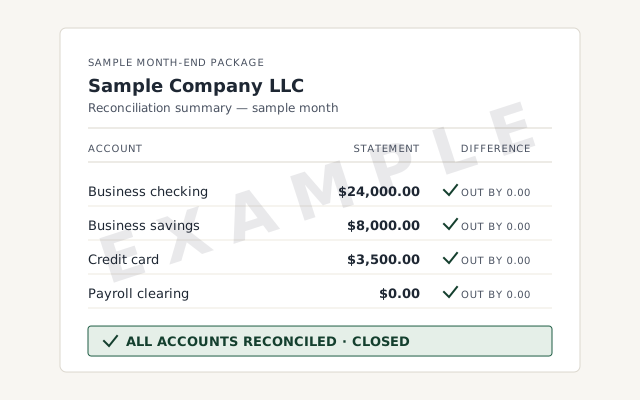 Sample workflow — not a specific client’s data
The reconciliation summary and margin-by-revenue-line report a monthly shop client receives.
Getting the account structure right before anything else is the whole discipline — read how we do it.
Read the chart of accounts methodA written reply within one business day.
Remote-first, nationwide
Mon–Sat · 8am–6pm CT
We work entirely remote — view-only access for the free review, QuickBooks' accountant access for the work itself, screen-share whenever you want to watch, and every re-split ticket and reconciled supplier credit recorded in writing.
Because they earn differently, and one blended margin tells you nothing about either. Labor is priced off a shop rate against technician cost; parts are priced off a markup against supplier cost. When both land in one service revenue account you can only read a combined gross margin, so parts pricing can erode for months while the overall number looks acceptable because labor is carrying it.
Sublet is work you send out to a specialist — machine shop, glass, alignment, towing, upholstery — and then bill to the customer. It needs its own revenue account and its own cost account, paired like parts and labor. Recorded that way, the sublet vendor's bill sits against the sublet you invoiced, and the margin on outsourced work is visible on its own rather than distorting your parts or labor numbers.
You can, and many shops do — a service item on the invoice at cost or with a markup is a perfectly ordinary way to bill it. The point is not how the customer sees it but where it lands: the amount you invoiced needs to hit sublet revenue and the vendor's bill needs to hit sublet cost. Whether you add margin is a pricing decision that belongs to you; whether the two sides are paired is the bookkeeping.
Treat it as its own revenue line with its own cost account. Rags, chemicals, fasteners, cleaner and the rest are consumed across many jobs and are usually recovered as a percentage on the ticket. Given a paired account, you can see whether what you charge for supplies actually covers what you spend on them — which is the whole reason the line exists and a question most shops cannot answer from a pooled file.
A core charge is a deposit on a returnable part, so it is not a cost of the job until it is clear the core is not going back. What makes cores difficult is the follow-through: the part goes back to the supplier and the credit is supposed to appear on a later statement, and QuickBooks has no way to notice that the credit never arrived. Tracking cores as an open item, and reconciling supplier credits against the returns that earned them, is the only thing that closes that loop.
It depends on how you buy. A shop that orders per job and fits the part the same week is running parts as a direct cost, and full inventory tracking adds counting work for very little return. A shop that stocks fast-movers, filters, fluids and tires has a genuine inventory asset that needs to be valued and counted. The free review is where we tell you which you are, including when the honest answer is that you do not need inventory turned on.
Yes, and most shops we work with are in that position. The management system runs the ticket and QuickBooks holds the accounting. What matters is how the day's or the ticket's totals arrive in QuickBooks: they need to land split by revenue line, not as one lump. We do not assert what any particular system exports, because those change — we work from what yours actually produces and map it to the right accounts.
No. Your shop rate, your parts markup and your supply percentage are commercial decisions that depend on your market, your technicians and your competition. What we do is make the results of those decisions visible, line by line, so you can see what each is actually returning rather than guessing from one combined figure.
Yes, and it is usually where we start. Repair shops fall behind because ticket volume is high and parts invoices arrive constantly from several suppliers. A catch-up splits the historical revenue back into its lines where the records support it, matches supplier bills to the jobs they belonged to, and rebuilds a margin you can actually read.
No. We keep the books — the paired revenue and cost lines, the sublet, the core and credit tracking — so the file is accurate and current. Your CPA sets tax positions, advises on inventory method, and files returns. Good bookkeeping makes that work faster; it does not replace it.
Separating what pools together is the recurring job: QuickBooks for agencies handles pass-through at a larger scale, inventory cleanup covers the parts on your shelf, chart of accounts cleanup is the structural fix underneath, and all industries lists the rest.
Not sure how bad it is?
Describe the file and a specialist will tell you which of these you are dealing with — including when the answer is that you don't need us.