Who’s responsible for your file
Your file is handled by Abid, Certified QuickBooks ProAdvisor — the same person through the review, the corrections and the hand-back.
About AbidQuickBooks for HOAs
An association runs two funds. Operating money pays this year's landscaping and utilities; reserve money is held for a roof that will need replacing in twelve years. QuickBooks has no fund accounting, so the separation is built from classes and maintained by discipline — and the reserve is not income.
QuickBooks for a community association means holding two separate pots of members' money in software that was built on the assumption there is only one.
An association collects assessments from owners and spends them on two quite different things. Some of it runs the community this year — landscaping, insurance, utilities, management. The rest is set aside for capital work that has not happened yet and may not happen for a decade, and that portion is not the board's to spend on anything else. Everything structural follows from keeping those apart and being able to show, at any point, what is in each. The association also has a receivables problem most small organizations do not: money is owed by dozens or hundreds of individual owners, and collection is done one owner at a time. This page is one industry lens on a full QuickBooks cleanup, pointed at an association's books.
QuickBooks has no native fund accounting, so the separation between operating and reserve is constructed on top of it — usually through class tracking — and the software will not stop anyone breaking it.
Where an assessment dollar goes
Assessments of 30,000.00 are billed to owners. Of that, 24,000.00 funds this year's operating costs and 6,000.00 is contributed to the reserve fund. The reserve contribution is recorded as a cost of the operating fund and an increase in reserve fund balance, not as income withheld. A confirmed panel notes that QuickBooks cannot enforce the split and only the setup and discipline prevent reserve money being spent on operating costs. Illustrative figures, not a real association.
The practical consequence is that an association's books are only as good as the tagging discipline behind them. Every transaction has to carry its fund, and nothing in the software complains when one does not — a reserve expense posted without its class simply lands in operating and the two balances quietly stop meaning what they say. That is why associations that have run for years without a bookkeeper who understood the structure usually need a rebuild rather than a correction: the drift is not one wrong entry but a slow blending. Turning class tracking on properly is the mechanical part, covered on our class tracking setup page; deciding what the classes must be, and holding the line afterwards, is the part that needs someone who knows what an association is.
Money moved to reserve is recorded as a cost of the operating fund and an increase in reserve fund balance — it leaves the operating result rather than sitting in income with a label attached.
The distinction sounds technical and it decides whether the annual budget means anything. Treated as revenue withheld, reserve funding never appears as a cost, the operating result looks healthier than it is, and the board is comparing spending to a budget that quietly ignores the largest commitment the association makes each year. Recorded as a movement out of operating, this year's share of future capital work sits alongside insurance and landscaping as one of the things the year's assessments had to cover — which is what it is. The reserve balance then accumulates in fund balance, where it can be reported to members as an amount rather than inferred. Whether the amount is adequate is a separate question entirely, answered by a reserve study and by whatever your governing documents and state law require. We do not answer it, and we will not publish a percentage; we record the board's decision and report the position accurately.
Assessments belong in the file as a receivable tracked to each unit or lot, because an association collects from dozens or hundreds of owners individually and a single monthly income figure cannot support any of that work.
Delinquency is the most common financial problem an association has, and it is worked owner by owner: a reminder, a late fee, a payment plan, eventually a lien or a lawyer, each step depending on knowing exactly what that owner owes and since when. A pooled receivable makes every one of those conversations a reconstruction. Setting up each unit so the association can see billed, paid and outstanding also produces the report a board actually asks for — an aged list showing who is behind and by how much — without anyone rebuilding it from bank statements. Special assessments sit alongside this rather than inside it: a one-off levy for a specific project belongs in its own tracking, because owners are entitled to see that money raised for a particular purpose was spent on it, and that is only demonstrable if it was never pooled. Where an association's receivable has already blurred, that is an accounts receivable cleanup with a community-association shape.
An association operates under governing documents, state law and a duty to its members, and none of those are things a bookkeeper interprets.
What the association must disclose, what reserves it is required to hold or study, what a board may spend without a member vote, how the association is taxed and what audit or review it owes its members are questions for the association's attorney and CPA. They vary by state and by the documents the community was formed under, and they change. We will not tell you that your reserve is underfunded, quote a funding percentage, or assert what your state requires — a bookkeeper doing that is guessing in a register that carries real consequences. What we own is the record: the fund separation held, the reserve balance accurate, the assessments receivable current, and everything reconciled so the board can make its decisions from numbers rather than impressions. Where the file cannot support something being asked of it, we say so plainly rather than producing a figure that looks like an answer.
How it starts
Every engagement opens with a free, view-only review. For an association the review asks one question first: can you show what is in the reserve, and prove it has not been spent?
Day 0
We read the file view-only, test whether operating and reserve are genuinely separated, and check whether assessments are tracked per unit or only in total.
Week 1
Class tracking established for operating and reserve, reserve funding set up as a movement out of operating, and special assessments given their own tracking.
Weeks 1–3
Historical transactions tagged to the fund they belonged to where the records support it, and assessments rebuilt as a receivable per unit.
Weeks 3–4
Both funds reconciled to their bank accounts, an aged assessment list produced, and anything that cannot be attributed listed for the board rather than absorbed.
Ongoing
Assessments billed and applied, fund tagging maintained, and a board package showing both fund balances and who is behind.
What changes
An association file built for the job can show a member what is in the reserve. A generic one shows one bank balance and a hope.
| Built for an association | Generic setup | |
|---|---|---|
| Operating and reserve tracked as separate funds | — | |
| Reserve funding recorded as a movement out of operating | — | |
| Reserve balance reportable to members | — | |
| Assessments tracked per unit | — | |
| Aged delinquency list available | — | |
| Special assessments tracked to their project | — | |
| Every transaction carries its fund | It depends | |
| Verdict | Two balances you can defend | One pool and an assumption |
What it costs
Every engagement is a fixed scope with a fixed fee, quoted after a free view-only review. The figures below are published starting floors; the review sets the real range for your file.
| Engagement | Typical range | Timeline | What's included |
|---|---|---|---|
| Association cleanup | From $1,500 | 2–4 weeks | Separate the funds, rebuild the reserve position, reconstruct assessments per unit, reconcile both banks. |
| Monthly bookkeeping | From $400/mo | Ongoing | Assessments billed and applied, fund tagging maintained, monthly board package with both fund balances. |
| Large or multi-association | Custom fixed quote | Scoped first | Several hundred units, multiple associations under one manager, or a live special-assessment project. |
| Get your range after a free review | |||
Association cleanup
Monthly bookkeeping
Large or multi-association
One firm does the work — the same specialist start to finish — and the reserve is treated as a balance a member could ask about, not a number that appears once a year in a budget.
The method is verification rather than assertion: both funds are reconciled to their own bank accounts, the reserve position is rebuilt from the contributions and expenditures that actually belonged to it, and assessments are evidenced per owner rather than assumed from deposits. Where a historical transaction cannot be attributed to a fund from the records available, it goes on a list for the board instead of being tagged to whichever fund makes the totals work. We hold the boundary firmly at governance and compliance: reserve adequacy, disclosure obligations, spending authority and the association's tax position belong to your attorney and CPA, and we will not publish a funding percentage or tell a board it is underfunded. And we are honest about the tooling — QuickBooks cannot enforce fund separation, so what you are buying is a structure plus the discipline to maintain it. Access stays minimal: view-only for the free review, QuickBooks' accountant access for the work, never your bank logins.
Skip us when the association is small and self-managed with no reserve to speak of, or when your management platform already keeps the ledger.
A six-unit association collecting modest dues, holding no meaningful reserve and spending on two or three things a year does not need fund accounting built on top of QuickBooks — a simple, well-kept record and an attentive treasurer will serve it better and cost far less. If a management company or a platform already runs the full accounting and produces the fund reporting, adding us creates a second version of the same numbers rather than a check on the first, and we will tell you that rather than sell alongside it. If what the board actually needs is a reserve study, legal advice on its documents, or help collecting from an owner who has stopped paying, those are three different professions and none of them is ours. And if your file already separates the funds and ages assessments per unit, there is nothing here to buy.
You do not have to take our word for it. Here is the evidence you can check — the deliverable you receive, the reference behind the method, and our response commitment.
Your file is handled by Abid, Certified QuickBooks ProAdvisor — the same person through the review, the corrections and the hand-back.
About Abid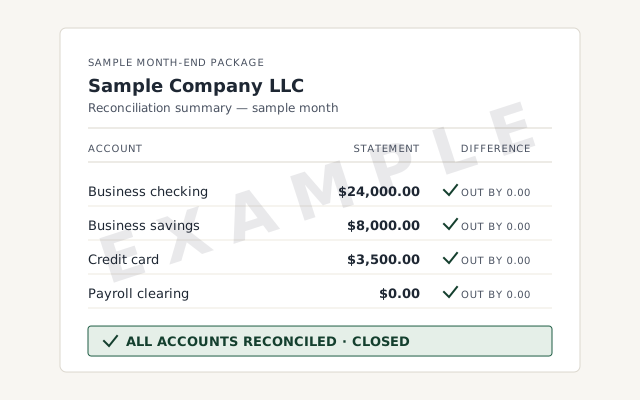 Sample workflow — not a specific client’s data
The two-fund balance summary and aged assessment list a board receives each month.
Tracking money by fund in software that has no funds is a setup discipline — read how we do it.
Read the class tracking methodA written reply within one business day.
Remote-first, nationwide
Mon–Sat · 8am–6pm CT
We work entirely remote — view-only access for the free review, QuickBooks' accountant access for the work itself, screen-share whenever the board wants to watch, and every fund reclassification and reconciled balance recorded in writing.
Neither, in the way most people first assume. Funding the reserve is a movement between funds: the operating fund records the contribution as a cost of the year, and the reserve fund balance increases by the same amount. The money is not revenue being held back and it is not a cost of running the community this year — it is this year's share of a roof that will be replaced years from now, moved out of operating so it cannot quietly be spent on landscaping.
Because they answer to different obligations and are spent under different authority. Operating money covers this year's recurring costs and the board manages it within the annual budget. Reserve money is set aside for identified future capital work and is generally restricted by the association's governing documents. Practitioners also point to a tax consequence for reserves that are not properly segregated, which is a question for the association's CPA rather than for us to assert.
No, not natively, and that is the honest starting point. QuickBooks is built for businesses with one undivided pool of money. Fund separation is constructed on top of it — usually through class tracking, sometimes with separate accounts — and the software cannot enforce it. Nothing stops a user posting a reserve expense to operating; only the setup and the discipline of whoever keeps the books prevent it.
The tooling looks similar and the mechanics are not. A nonprofit's restriction comes from a donor and is recognized as revenue carrying that restriction, then released when the purpose is met. An association's reserve designation comes from its own governing documents and a board decision, and it is funded by moving money out of the operating result rather than by recognizing revenue with a label on it. Different origin, opposite direction of entry, and no donor to report to.
As a receivable per unit, not as a lump of monthly income. Each unit or lot is set up so the association can see what that owner was billed, what they paid and what is outstanding — because collection is done owner by owner and a pooled figure cannot support it. Delinquency is the single most common financial problem in an association, and an aged balance per unit is what makes it workable.
It is a one-off levy for a specific purpose, usually a capital project the reserve cannot cover, and it belongs in its own tracking rather than mixed with regular dues or with the reserve. Owners are entitled to see that the money raised for a specific project was spent on that project, and that is only demonstrable if it was never pooled with anything else in the first place.
No. Reserve adequacy comes from a reserve study prepared by a qualified provider and from whatever your state law and governing documents require, and both vary considerably. We will not publish a percentage or tell you that you are underfunded — that is not a bookkeeping judgment. What we do is record the funding decision the board makes and report the reserve balance accurately so the board and the members can see where it stands.
No. What an association must disclose to members, what its state requires, what its governing documents oblige and how it is taxed are matters for the association's attorney and CPA. We keep the books so those obligations can be met from accurate numbers, and we say plainly when the file cannot support something being asked of it.
It depends on how much your management platform does. Some run the full ledger and an association needs nothing else; others handle assessments, work orders and owner communication while the accounting lives elsewhere. Where both are in use, the important thing is that one of them is the accounting record and the other reconciles to it, rather than two systems each holding a partial version. We will tell you honestly if your platform already covers this.
No. We keep the books — the fund separation, the reserve balance, the assessments receivable — so the file is accurate and current. Your CPA handles the association's tax position and any audit or review the members or the state require. Good bookkeeping makes that work faster; it does not replace it.
Tracking money by fund comes up in more than one setting: QuickBooks for nonprofits does it for donor-restricted gifts, which work the other way round, class tracking setup is the mechanism underneath both, A/R cleanup handles assessments that blurred, and all industries lists the rest.
Not sure how bad it is?
Describe the file and a specialist will tell you which of these you are dealing with — including when the answer is that you don't need us.