Who’s responsible for your file
Your file is handled by Abid, Certified QuickBooks ProAdvisor — the same person through the review, the corrections and the hand-back.
About AbidQuickBooks for property management
A management company collects rent it does not own. That rent is a liability owed to the property owner, and the only part the company earns is the management fee. Books built the ordinary way report gross rent as income, describing a business several times the real size. We build the trust structure and prove it.
QuickBooks for a property management company means building the file around a fact that inverts ordinary bookkeeping: most of the money moving through the business was never the business's to earn.
A management company takes in rent, holds tenant deposits, keeps reserves for repairs, pays vendors on owners' behalf and disburses the balance — and out of that entire flow, the only amount it earns is its fee. Every structural decision follows from that. Rent is a liability, not revenue. Owner money and company money live in different accounts and must never fund each other. What the company owes has to be provable per owner, not just in total. This is genuinely a different business from owning rental property yourself, where the rent is your income; if that is your situation, QuickBooks for real estate is the page you want. This page is one industry lens on a full QuickBooks cleanup, pointed at a management company's books.
Rent collected from a tenant belongs in a trust liability account set up as an other current liability, because the company owes it onward — and only the management fee earned on that rent is moved into income.
What a rent collection actually is
A tenant pays 2,000.00 of rent into the trust bank account. The whole amount is recorded as a trust liability, not income. A management fee of 200.00 is earned and moved to the operating account as the company's revenue; 1,800.00 remains owed to the owner and is disbursed to them. A confirmed panel notes that booking the full 2,000.00 as income overstates revenue tenfold and commingles owner money. Illustrative figures, not a real company.
The movement runs in one direction and each step has a matching entry. Rent arrives and increases the trust liability. A repair paid on the owner's behalf reduces it. The fee is earned, recognized as income, and transferred out of trust into the company's operating account. The remainder is disbursed and the liability falls to what is genuinely still held. Nothing in that sequence ever records gross rent as revenue, and nothing pays one owner's cost out of another owner's balance. Two rules keep it honest: no owner balance goes negative, and money only leaves trust for the owner it belongs to.
A management company proves its trust position with three balances that must all match: the trust bank statement, the trust liability recorded in the books, and the sum of every individual owner and tenant ledger.
Reconciling the bank to the books is only two of those legs, and two legs can agree while the money is allocated to entirely the wrong people. A trust account can tie to the penny at the bank and still have one owner's balance quietly funding another's repair, or a security deposit that was spent and never noticed, because nothing in a two-way tie asks who each dollar belongs to. The third leg — the sum of the individual ledgers — is what makes the position attributable rather than merely balanced. That mechanic is not unique to property management; it is the same three-way discipline that governs a law firm's client trust account, explained in full on our three-way reconciliation reference. What differs here is the context: the beneficiaries are owners and tenants rather than clients, the inflow is rent rather than a retainer, and the proof you owe them is a monthly owner statement. Where a trust account has already drifted far enough that the legs cannot be made to agree, that is a trust account cleanup.
QuickBooks has no native concept of a property or a tenant, so the structure is assembled from customers, sub-customers and vendors — and getting that mapping right is what makes per-property and per-owner reporting possible at all.
Each property is set up as a customer, and each tenant as a sub-customer beneath the property they occupy, so activity rolls up per property while remaining readable per tenant. An owner sits on both sides of the relationship: a customer, because you invoice them for the management fee, and a vendor, because you disburse their funds to them. Security deposits and repair reserves are held in liability accounts per property, never as income, because a deposit is the tenant's money until the lease ends and a reserve is the owner's money until it is spent. None of this is exotic, but all of it has to be decided before transactions start landing, because retrofitting attribution onto a year of pooled entries is the expensive version of the same work. Getting the account structure right up front is a chart of accounts job with a management-company shape.
Connecting the trust bank account to QuickBooks and letting the feed categorize deposits is the single most damaging thing a management company can do to its books.
The feed has no way to know that an arriving rent payment is not earnings. It sees money landing in a bank account and offers to record it as income, and once that pattern is accepted a few times the rule persists and every subsequent rent payment follows it. Two failures arrive together: revenue is overstated by the entire gross rent roll, and owner money is recorded inside the company's own income rather than held apart from it. Those are precisely the two outcomes trust accounting exists to prevent, introduced by a convenience feature nobody thought of as a decision. The correction is not a categorization rule but a structural one — rent enters as a liability through the transaction that records what it is, and the trust account is reconciled deliberately rather than fed. Where a file has been running on the feed for a year or more, the rebuild is a cleanup before it is anything else.
How it starts
Every engagement opens with a free, view-only review. For a management company the review asks one question first: do the three legs agree, and can you prove it per owner?
Day 0
We read the file view-only, test whether rent is landing as a liability or as income, and check whether the trust bank, the liability and the owner ledgers agree.
Week 1
Trust liability and deposit accounts established, properties and tenants mapped as customers and sub-customers, owners set up on both sides, management fee income separated.
Weeks 1–3
Historical receipts and disbursements attributed to the owners and properties they belonged to, and rent wrongly recorded as income reversed out.
Weeks 3–4
Trust bank reconciled to the liability and to the sum of the ledgers, with anything that cannot be attributed listed for you rather than absorbed.
Ongoing
Rent and disbursements posted as they happen, fees recognized, and a monthly close where the owner statements tie to the liability before they go out.
What changes
A management file built for the business shows a company the size it actually is and can prove what it holds. A generic one reports the rent roll as revenue.
| Built for a manager | Generic setup | |
|---|---|---|
| Rent held as a trust liability | — | |
| Management fee separated as revenue | — | |
| Balance provable per owner | — | |
| Deposits and reserves held per property | — | |
| Three-way tie, not just a bank reconcile | — | |
| Owner statements tie to the liability | — | |
| Trust account kept off the live feed | It depends | |
| Verdict | Provable, per owner | The rent roll as revenue |
What it costs
Every engagement is a fixed scope with a fixed fee, quoted after a free view-only review. The figures below are published starting floors; the review sets the real range for your file.
| Engagement | Typical range | Timeline | What's included |
|---|---|---|---|
| Management company cleanup | From $1,500 | 2–4 weeks | Rebuild the trust liability, attribute history per owner, separate fee revenue, tie the three legs. |
| Monthly bookkeeping | From $400/mo | Ongoing | Rent and disbursements posted, fees recognized, owner statements tied to the liability each month. |
| Large portfolio | Custom fixed quote | Scoped first | Many owners or properties, multiple trust accounts, or more than one managing entity. |
| Get your range after a free review | |||
Management company cleanup
Monthly bookkeeping
Large portfolio
One firm does the work — the same specialist start to finish — and the trust position is treated as a number you can be asked to defend per owner, not a total that happens to reconcile.
The method is verification rather than assertion. Each owner's balance is rebuilt from the receipts and disbursements that actually belonged to them, so a balance can be evidenced rather than assumed, and anything the records cannot attribute goes on a list for you instead of being absorbed into a total that ties. Owner statements are checked against the liability before they are sent, because a statement is a claim and an unreconciled claim is the expensive kind of error. And we hold the boundary firmly at compliance: how trust funds must be held, how quickly they are disbursed and what your state's real-estate regulator or your broker's licence requires are not ours to interpret. We build and reconcile the structure and keep it consistent with what your regulator, your CPA or your attorney tells you. Access stays minimal: view-only for the free review, QuickBooks' accountant access for the work, never your bank logins.
Skip us when you own the properties yourself, or when what you need is management software rather than a bookkeeper.
If the buildings are yours and you rent them out directly, none of the trust structure on this page applies — the rent genuinely is your income, and QuickBooks for real estate covers that setup properly. If your real problem is that you cannot track work orders, lease renewals, tenant screening or maintenance scheduling, that is property management software; we work alongside those systems rather than replacing them, and we will say so rather than sell you a cleanup that does not address the complaint. And if your file already holds rent as a liability, separates the fee, and ties three legs monthly, there is nothing here to buy. The free review will tell you which case you are in, including when the answer is that you do not need us.
You do not have to take our word for it. Here is the evidence you can check — the deliverable you receive, the reference behind the method, and our response commitment.
Your file is handled by Abid, Certified QuickBooks ProAdvisor — the same person through the review, the corrections and the hand-back.
About Abid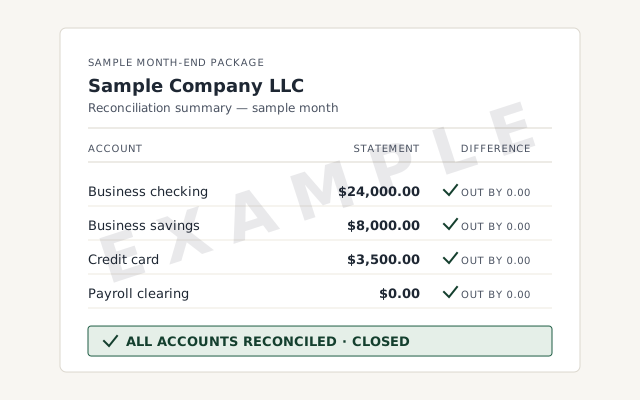 Sample workflow — not a specific client’s data
The three-way tie and owner-balance summary a monthly management client receives.
Three balances proving one position is the discipline underneath all of this — read the reference.
Read the three-way reconciliation referenceA written reply within one business day.
Remote-first, nationwide
Mon–Sat · 8am–6pm CT
We work entirely remote — view-only access for the free review, QuickBooks' accountant access for the work itself, screen-share whenever you want to watch, and every attributed receipt, disbursement and reconciled leg recorded in writing.
No. Rent collected on an owner's behalf is money passing through your hands, so it belongs in a trust liability account — an other current liability — because you owe it onward. The only part that is genuinely your revenue is the management fee you earn on it. A file that books gross rent as income reports a company several times larger than the one you actually run, and pays tax on money that was never yours.
Connecting the trust bank account to QuickBooks and letting the feed categorize deposits. QuickBooks has no way of knowing that an incoming rent payment is not your earnings, so it books each one as income by default. The result is overstated revenue on top of owner money mixed into the company's own records — the two failures trust accounting exists to prevent, both introduced by a convenience feature.
It is the proof that three balances agree: the trust bank statement, the trust liability recorded in the books, and the sum of every individual owner and tenant ledger. Two-way reconciliation only proves the bank agrees with your books; it says nothing about whether the money is allocated to the right people. All three legs matching is what shows every dollar is accounted for and attributable.
QuickBooks has no native concept of a property or a tenant, so the structure is built from what it does have. Properties are set up as customers and tenants as sub-customers beneath the property they occupy, which gives you activity per property and per tenant. An owner is both a customer, because you invoice them for the management fee, and a vendor, because you disburse their share to them.
As liabilities, per property, and never as income. A security deposit is the tenant's money held until the lease ends; a repair reserve is the owner's money held against future work. Neither has been earned by you. Both belong in liability accounts and both form part of the total the trust bank has to cover.
It must not, and the ledger structure is what prevents it. Each owner's balance is tracked separately and no owner balance should ever go negative — a repair on one property is paid from that owner's funds, not from the pooled cash that happens to be sitting in the trust account. A trust account can reconcile to the bank perfectly while one owner is quietly funding another, which is exactly what the per-owner leg of the three-way tie catches.
Yes, and if they do not, one of the two is wrong. The monthly statement you send an owner is a claim about what was collected, what was spent and what is owed to them. When the sum of those statements does not equal the trust liability on your balance sheet, the discrepancy is real money somewhere, and finding it later is far more expensive than reconciling it monthly.
No, and we are firm about that line. How trust funds must be held, how quickly they are disbursed, what reporting your state requires and what your broker's licence obliges are set by your state's real-estate regulator, not by us. We build and reconcile the structure in QuickBooks and keep it consistent with what your regulator, your CPA or your attorney tells you. We will not assert those rules or claim to keep you compliant with them.
Yes, and it is usually where we start. Management files fall behind because the transaction count is high, the money is not yours, and the person who knows which property a repair belonged to is the one out on site. A catch-up rebuilds the per-owner ledgers, attributes the historical receipts and disbursements, and gets the three legs to agree before anything else is trusted.
Neither. Your management software runs leases, work orders and tenant communication, and we work alongside it rather than replacing it. Your CPA sets tax positions and files returns. What we own is the accounting record — the trust liability, the per-owner ledgers, the management fee revenue — so it is accurate, current and provable.
Holding other people's money is one discipline in several settings: three-way reconciliation is the reference behind the tie, trust account cleanup is the fix when the legs will not agree, QuickBooks for real estate covers owning the property instead of managing it, QuickBooks for real estate agents covers earning a commission on the sale of one, QuickBooks for short-term rentals handles nightly platform-booked stays, and all industries lists the rest.
Not sure how bad it is?
Describe the file and a specialist will tell you which of these you are dealing with — including when the answer is that you don't need us.