Who’s responsible for your file
Your file is handled by Abid, Certified QuickBooks ProAdvisor — the same person through the review, the corrections and the hand-back.
About AbidQuickBooks for short-term rentals
A booking platform never sends what the guest paid. It takes its fee first, may hold or remit tax, and pools several reservations across several properties into one deposit. Recorded as a single income line, that deposit understates revenue, loses the fee as a deduction, and hides which property earned. The fix is decomposition, per booking and per property.
QuickBooks for a short-term rental means rebuilding, from the platform's own records, a picture of the business that the bank account alone can never show.
A long-term landlord gets a rent payment that equals the rent. A short-term host gets a deposit that equals almost nothing recognizable: several stays, at possibly several properties, with a platform commission already removed, cleaning fees folded in, and tax handled one of two entirely different ways depending on where the property sits. Every question a host actually has — which property earns, whether the nightly rate covers the turnover cost, what the platform really costs in a year — is unanswerable from the deposit. It is answerable from the reservation detail, once the entries are built from there. If you let long-term instead, the mechanics are different enough that QuickBooks for real estate is the page you want. This page is one industry lens on a full QuickBooks cleanup, pointed at a short-term rental's books.
For a single reservation the payout is the accommodation fare plus the cleaning fee, less the platform's host service fee and any refunds — so recording the deposit as revenue understates the top line by exactly the fee you were charged.
One booking, one deposit, three entries
A guest booking is made up of an accommodation fare of 900.00 and a cleaning fee of 100.00, a subtotal of 1,000.00. The platform deducts a host service fee of 150.00 and deposits 850.00. The books must record 1,000.00 of gross revenue and 150.00 of platform fee expense, not 850.00 of income. A confirmed panel notes that recording only the deposit understates revenue and discards the fee deduction. Illustrative figures, not a real booking.
Both halves matter and both are lost by the shortcut. The revenue understatement is obvious once stated. The quieter loss is the fee: an expense that was never recorded cannot be deducted, so a host who books only net deposits pays for the platform twice — once in commission and again in tax on income that was never received. Refunds behave the same way, disappearing into a smaller deposit rather than appearing as the reversal they are. This is the same decomposition problem that runs through every platform-mediated business on this site — it is what our ecommerce pages and the Stripe reconciliation work are built on. What is specific here is that the units being pooled are stays at physical properties, which makes the second question unavoidable.
A single payout routinely covers reservations at more than one property, so attribution has to be rebuilt from the reservation detail rather than apportioned from the deposit.
Splitting a lump sum by any rule you invent — floor area, nightly rate, a guess — produces numbers that look precise and are not, and they will be wrong in a way nothing downstream can detect. The reservation records behind the payout already say which stay belonged to which listing, and that is the only honest source for the split. Once attribution exists, properties are tracked either as customers or through class or location tracking, and the questions a host actually cares about become answerable: which property earns after cleaning and platform cost, whether a second listing was worth acquiring, what a low season really costs. Per-property tracking is the one mechanic short-term rentals share with long-term letting, and the setup is the same on both — the class tracking setup page covers turning it on properly.
Occupancy tax is recorded one of two completely different ways depending on the jurisdiction, and the deciding question is whether the platform remits it on your behalf or you remit it yourself.
Airbnb states that it has agreements with some tax authorities to collect occupancy tax at the time of booking and remit it to the authority on the host's behalf, and that it does not have such agreements everywhere — where none exists, calculation, collection and remittance remain entirely the host's responsibility. Those two situations demand opposite entries. Where the platform collects and remits, the tax never becomes yours to hold and recording it as a liability creates a balance that can never clear. Where you collect it, the money sitting in your account is not revenue at all; it is held for a tax authority, and it belongs in a liability account that is cleared when you remit. A host operating in more than one jurisdiction can genuinely be in both situations at once, which is why this is settled per property rather than once for the business. The rates, the registration requirements and the filing deadlines are set by state and local authorities and are not ours to assert — we build the structure that records what was collected and owed, and keep it consistent with what your CPA or the authority tells you.
There is a boundary at the low end of short-term renting where the ordinary reporting treatment does not apply, and it is worth settling with a CPA before any structure is built.
The IRS provides that where a dwelling unit is used as a residence and is rented for fewer than fifteen days in the year, the rental income is not reported and rental expenses are not deducted. The condition that matters is the residence one: the rule turns on the property being used as a home, so it has no application to a property run purely as a rental business, which is what most hosts reading this page operate. Whether a given situation meets the test is a determination for your CPA, and we record according to the position they set rather than reaching one ourselves. The reason it belongs on this page at all is practical — a host who occasionally lets their own home is in a different accounting situation from a host running two dedicated listings, and building the second structure for the first case creates work and reporting that may not be wanted.
How it starts
Every engagement opens with a free, view-only review. For a short-term rental the review asks one question first: does your revenue equal what guests paid, or what the platform sent?
Day 0
We read the file view-only, compare recorded revenue against the platform's own reports, and check whether occupancy tax is recorded to match who actually remits it.
Week 1
Gross revenue, cleaning income, platform fees and any tax liability given their own accounts, and per-property tracking set up as customers or classes.
Weeks 1–3
Historical payouts decomposed from the reservation detail, attributed per property, with fees and refunds recorded as the separate facts they are.
Weeks 3–4
Per jurisdiction, the tax treatment confirmed against what your CPA or the authority states, and any liability that could never clear removed.
Ongoing
Payouts decomposed as they arrive, reconciled to the deposits, and a month-end package that reports revenue and cost per property.
What changes
A short-term rental file built for the model reports what guests actually paid and which property earned it. A generic one reports the bank deposit and calls it revenue.
| Built for a host | Generic setup | |
|---|---|---|
| Gross booking revenue recorded | — | |
| Platform fee visible as an expense | — | |
| Cleaning fee treated as revenue | — | |
| Payout attributed per property | — | |
| Occupancy tax matched to who remits | — | |
| Refunds recorded as reversals | It depends | |
| Deposits reconcile to the platform report | — | |
| Verdict | What guests actually paid | Whatever the bank sent |
What it costs
Every engagement is a fixed scope with a fixed fee, quoted after a free view-only review. The figures below are published starting floors; the review sets the real range for your file.
| Engagement | Typical range | Timeline | What's included |
|---|---|---|---|
| Short-term rental cleanup | From $1,500 | 2–4 weeks | Decompose historical payouts, rebuild gross revenue per property, separate fees, settle the tax treatment. |
| Monthly bookkeeping | From $400/mo | Ongoing | Payouts decomposed and reconciled, per-property reporting, month-end package each period. |
| Portfolio | Custom fixed quote | Scoped first | Several listings, more than one platform, or properties across multiple tax jurisdictions. |
| Get your range after a free review | |||
Short-term rental cleanup
Monthly bookkeeping
Portfolio
One firm does the work — the same specialist start to finish — and revenue is rebuilt from the reservation records rather than accepted from the bank feed.
The method is verification rather than assertion. Each payout is decomposed against the platform's own transaction detail, so gross revenue can be evidenced rather than assumed, and the fee, the cleaning income and any tax are recorded as the separate facts they are. Where a payout cannot be attributed to specific reservations from the records available, it goes on a list for you rather than being apportioned across properties by a rule we invented. We do not claim what any platform's reports contain or how its exports behave, because those change and naming a feature is not the same as promising one — we work from what yours actually produces. And the tax boundary is held firmly: rates, registration and filing obligations belong to the authorities and your CPA, and we record the position they set. Access stays minimal: view-only for the free review, QuickBooks' accountant access for the work, never your bank or platform logins.
Skip us when you let one property occasionally, or when the properties are managed for you by someone else.
A host with a single listing and a handful of stays a year has very little to decompose, and the boundary discussed above may mean the activity is not reported at all — a conversation with a CPA is worth more than a bookkeeping engagement. If a management company runs your listings and sends you owner statements, the accounting problem being described here is theirs rather than yours, and QuickBooks for property management is the page that covers it. If your real need is a channel manager, a dynamic pricing tool or something to coordinate cleaners between stays, that is operations software and we work alongside it rather than replacing it. And if your file already records gross revenue, separates fees and attributes per property, there is nothing here to buy. The free review will tell you which case you are in, including when the answer is that you do not need us.
You do not have to take our word for it. Here is the evidence you can check — the deliverable you receive, the reference behind the method, and our response commitment.
Your file is handled by Abid, Certified QuickBooks ProAdvisor — the same person through the review, the corrections and the hand-back.
About Abid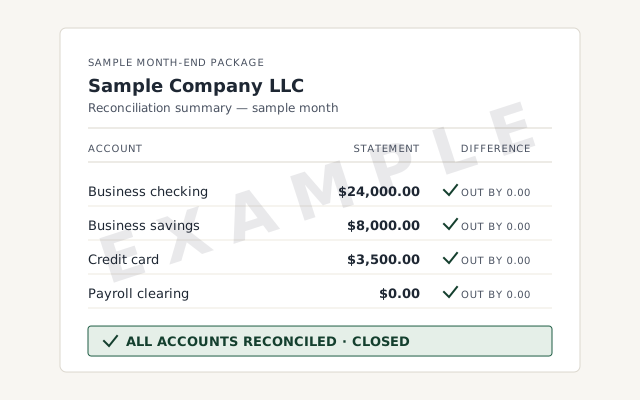 Sample workflow — not a specific client’s data
The payout reconciliation and revenue-per-property report a monthly host client receives.
Splitting a platform settlement back into its parts is the same discipline everywhere — read how we do it.
Read the Stripe reconciliation methodA written reply within one business day.
Remote-first, nationwide
Mon–Sat · 8am–6pm CT
We work entirely remote — view-only access for the free review, QuickBooks' accountant access for the work itself, screen-share whenever you want to watch, and every decomposed payout and attributed reservation recorded in writing.
No, and treating it as revenue is the most common error in short-term rental books. The deposit is a net figure: the guest paid a nightly rate plus a cleaning fee, the platform deducted its host service fee before sending anything, and refunds may have been netted out too. Booking only what landed understates your gross revenue and quietly discards the platform fee as a deductible cost, because an expense you never recorded cannot be claimed.
For a single reservation it is the accommodation fare plus the cleaning fee, less the platform's host service fee, less any refunds. Depending on the jurisdiction it may also carry occupancy tax the platform collected, or exclude tax the platform already remitted. A payout covering several reservations pools all of that, which is why the platform's own transaction report — not the bank deposit — is the document the entries have to be built from.
From the reservation detail behind it, not by apportioning the deposit. A single payout routinely covers bookings at more than one property, so the split has to come from the underlying reservations, each attributed to the property it belongs to. Properties are tracked as customers or through class or location tracking, which gives you revenue and cost per property instead of one pooled rental line.
It depends on the jurisdiction, and the answer changes the entry. Airbnb has agreements with some tax authorities to collect and remit occupancy tax on the host's behalf; it does not have them everywhere, and where no agreement exists calculation, collection and remittance stay with the host. Where the platform remits, the tax is not yours to record as a liability. Where you remit, it is money you are holding for a tax authority and it has to be recorded and cleared.
You either double-count or omit it. Recording tax the platform already remitted creates a liability on your balance sheet that will never clear and never should. Failing to record tax you collected yourself leaves the money looking like revenue and hides an obligation you genuinely owe. Both are quiet errors that surface at the worst possible moment, which is why the first question we ask is who actually remits in your jurisdiction.
It is revenue. A guest pays it as part of the booking and the platform includes it in the amount its host service fee is calculated on, so it belongs in your gross revenue rather than being netted against what you pay a cleaner. The cleaner's invoice is a separate cost. Netting the two hides both the income and the expense and makes the margin on turnover impossible to read.
Possibly, and it is worth asking your CPA before you build anything. The IRS provides that where a dwelling unit is used as a residence and rented for fewer than 15 days in the year, the rental income is not reported and rental expenses are not deducted. It turns on the property being used as a residence, so it does not apply to a property run purely as a rental. Whether your situation meets the test is a determination for your CPA, not for us — we record according to the position they set.
No. Occupancy, lodging and transient tax rates, registration requirements and filing deadlines are set by state and local authorities and vary considerably, and short-term rental rules are changing in many places. We build the structure that records what was collected and what is owed, and keep it consistent with what your CPA or the authority tells you. We will not assert a rate or a filing obligation.
Yes, and it is usually where we start. Short-term rental files fall behind because payouts arrive constantly, each one pools several reservations, and the platform reports are the only place the detail lives. A catch-up rebuilds the gross revenue from the reservation records, separates the fees, attributes everything per property, and reconciles the result to the deposits that actually landed.
No. We keep the books — the decomposed payouts, the per-property attribution, the tax position as recorded — so the file is accurate and current. Your CPA decides the reporting treatment, including whether any residence-use rule applies to you, and files returns. Good bookkeeping makes that work faster; it does not replace it.
A pooled platform deposit is the same puzzle in several trades: QuickBooks for ecommerce splits marketplace payouts, Stripe reconciliation is the mechanic in isolation, QuickBooks for real estate covers letting long-term instead, QuickBooks for property management applies when you run listings for other owners, and all industries lists the rest.
Not sure how bad it is?
Describe the file and a specialist will tell you which of these you are dealing with — including when the answer is that you don't need us.