Who’s responsible for your file
Your file is handled by Abid, Certified QuickBooks ProAdvisor — the same person through the review, the corrections and the hand-back.
About AbidQuickBooks for dental practices
A dental practice runs on two financial records. The practice management system holds production — everything charged at full fee — and QuickBooks holds collections, the cash that actually arrived. Neither is wrong, but if nobody reconciles them monthly they drift apart, and the gap stops being explainable. We build the ledger side and tie it to yours each month.
QuickBooks for a dental practice means running the money side of a business whose operational numbers live somewhere else entirely, and keeping the two views honest about each other.
Every dental practice already has a system that knows what was scheduled, what was performed and what each patient was charged. That system is not the accounting file and should not become one. What the ledger owns is the cash: what was collected, what it cost to run the practice, what the payroll was, what the owner took. The discipline that makes both trustworthy is the monthly comparison between them — and it is the step most practices skip, because nothing forces it and nothing complains when it is missed. The write-off arithmetic underneath sits in the same family as any insurance-billed practice, which our medical practices page covers in full; what follows here is what is specific to a dental office. This page is one industry lens on a full QuickBooks cleanup.
Production is the gross value of dentistry performed at the full fee schedule before any adjustment, and collection is the cash that actually arrived — and the important structural point is that only the second one posts to the ledger.
The bridge between the two records
Production of 100,000.00 is recorded in the practice management system. Contractual adjustments of 18,000.00 are deducted to give net production of 82,000.00. A movement in receivables of 2,000.00 is deducted to give collections of 80,000.00, which is the figure that posts to QuickBooks. A confirmed panel notes that production never enters the ledger and the monthly bridge is the control. Illustrative figures, not a real practice.
Keeping production out of the accounting file is a deliberate choice rather than an oversight. Mirroring it in QuickBooks produces a second version of numbers the practice management system already owns, and two versions of the same figure do not check each other — they just disagree eventually, and then somebody has to decide which one to believe. The useful arrangement is one record for treatment and one for money, joined by a monthly bridge that starts at production, subtracts adjustments to reach net production, allows for the movement in what patients and insurers still owe, and lands on the cash that was actually banked. When that bridge is run every month the difference is always small and always explainable. When it is skipped for a year, the two records have quietly become two different accounts of the same business.
Outside lab work — crowns, bridges, dentures, appliances — belongs in its own cost account rather than inside general dental supplies, because it is a direct cost of identifiable cases and it moves for reasons supplies never do.
Lab cost follows case mix and the labs chosen: a month heavy in fixed prosthetics costs more than a month of hygiene and restorative work, and switching to a premium lab changes the number without anything else in the practice changing at all. Supply cost follows patient volume and purchasing discipline. Merged into a single expense line, neither signal survives, and a practice watching its margin slip has no way to tell whether it is paying more for lab work, using more supplies, or simply collecting less. Practices commonly watch lab cost as a ratio against collections for exactly this reason — the ratio is only available if the account exists. We do not publish a target for it; what that ratio should be depends on your case mix and your fee schedule, and it is a conversation for you and your CPA or consultant rather than a number we assert.
Pooling every reduction into one adjustment account destroys the only useful thing adjustments tell you, which is which kind of them is growing.
Three different things end up in that bucket and they have nothing in common. A contractual adjustment is the difference between your fee and the rate an insurer already contracted to pay — you agreed to it in advance and it is a cost of participating in that plan. A courtesy, senior or staff discount is a pricing decision the practice made and can change. A written-off balance is a debt that turned out to be uncollectible, which is a collections problem. Growth in the first means your plan mix is shifting; growth in the second means discounting has crept; growth in the third means the front desk needs attention. Reported as one number, all three look identical and none can be acted on. The mechanics of recording each are shared with any insurance-billed practice and are set out on our medical practices page; what matters here is that a dental file usually needs more than one adjustment account, and most arrive with exactly one.
Associate dentists are commonly paid a percentage of their own production or collections, which turns an accounting detail into a payroll obligation and makes the monthly reconciliation something more than good practice.
The attribution itself comes from the practice management system, which knows who performed what. The exposure is that compensation is being calculated from figures nobody has tied to the money. If production and collections have not been reconciled, an associate is being paid from a number that cannot be evidenced, and any later correction becomes a conversation about someone's pay rather than a bookkeeping adjustment. The same applies to hygiene compensation where it is structured the same way. We do not advise on how these arrangements should be set — that is a matter for you, your CPA and your counsel — but we do make sure the figures underneath them reconcile, and we say plainly when they do not. Where payroll has drifted more broadly, that is a payroll cleanup in its own right.
How it starts
Every engagement opens with a free, view-only review. For a dental practice the review asks one question first: when did the ledger and the practice management system last agree?
Day 0
We read the file view-only, compare a month of collections against what the practice management reports show, and check whether lab and adjustment accounts exist at all.
Week 1
Lab fees separated from supplies, adjustment accounts split by cause, revenue grouped so the practice reads by category rather than as one line.
Weeks 1–3
Prior periods reclassified where the records support it, with lab cost pulled back out of supplies and pooled adjustments separated.
Weeks 3–4
A repeatable tie from production through adjustments and receivable movement to banked collections, with anything unexplained listed rather than absorbed.
Ongoing
Collections posted, the bridge run every month, and a month-end package that shows cost ratios against collections instead of raw totals.
What changes
A dental file built for the practice reconciles to the system that runs the schedule. A generic one records deposits and leaves the gap unexplained.
| Built for a practice | Generic setup | |
|---|---|---|
| Collections posted, production left in the PM system | It depends | |
| Monthly bridge between the two records | — | |
| Lab fees in their own cost account | — | |
| Adjustments split by cause | — | |
| Revenue grouped by treatment category | — | |
| Associate production attribution reconciled | — | |
| Cost ratios readable against collections | — | |
| Verdict | Two records that agree | Two records that drift |
What it costs
Every engagement is a fixed scope with a fixed fee, quoted after a free view-only review. The figures below are published starting floors; the review sets the real range for your file.
| Engagement | Typical range | Timeline | What's included |
|---|---|---|---|
| Dental practice cleanup | From $1,500 | 2–4 weeks | Separate lab from supplies, split adjustment accounts, rebuild history, establish the monthly bridge. |
| Monthly bookkeeping | From $400/mo | Ongoing | Collections posted, the bridge run each month, month-end package with cost ratios. |
| Multi-location or group | Custom fixed quote | Scoped first | More than one location, several associates, or a group structure needing separate reporting. |
| Get your range after a free review | |||
Dental practice cleanup
Monthly bookkeeping
Multi-location or group
One firm does the work — the same specialist start to finish — and the bridge between your two records is run every month rather than described in a proposal and quietly dropped.
The method is verification rather than assertion: collections are tied to the deposits that landed and to the reports your practice management system produces, so the ledger can be evidenced rather than assumed. Where a month cannot be bridged from the records available, it goes on a list for you instead of being forced to balance with an adjusting entry nobody can explain later. We do not claim what any particular practice management system exports, because those change and naming a feature is not the same as promising one — we work from what yours actually produces. We publish no benchmark ratios, because the right lab or supply percentage depends on your case mix and fee schedule and belongs to you and your advisors. And we work with financial data only: patient names, procedure codes and claim-level detail are neither needed nor requested. Access stays minimal — view-only for the free review, QuickBooks' accountant access for the work, never your bank logins.
Skip us when you are a single-chair practice collecting almost entirely private pay, or when what you need is help running the practice management system rather than the ledger.
A small practice with no insurance participation has very little adjustment structure to build — collections are close to production and the bridge that justifies this page barely exists. Straightforward monthly bookkeeping serves you better. If the real problem is that claims are not going out, ageing is not being worked, or the schedule is not being filled, that is practice management and billing, and it is a different profession from ours; we will say so rather than sell a cleanup that does not touch the complaint. And if your file already separates lab from supplies, splits adjustments and reconciles monthly, there is nothing here to buy. The free review will tell you which case you are in, including when the answer is that you do not need us.
You do not have to take our word for it. Here is the evidence you can check — the deliverable you receive, the reference behind the method, and our response commitment.
Your file is handled by Abid, Certified QuickBooks ProAdvisor — the same person through the review, the corrections and the hand-back.
About Abid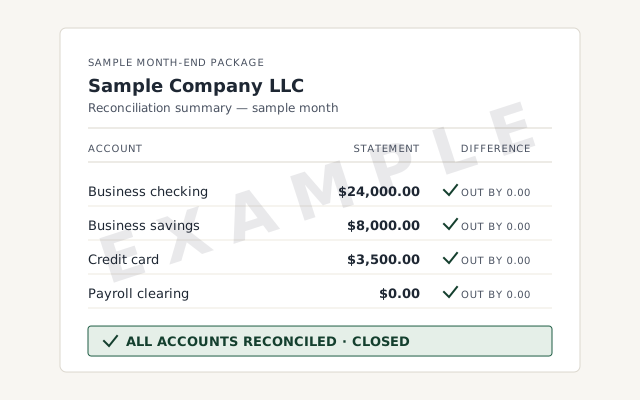 Sample workflow — not a specific client’s data
The monthly bridge and cost-ratio summary a dental client receives.
How billed and collected are told apart in any insurance-billed practice — read the full treatment.
Read the medical practices methodA written reply within one business day.
Remote-first, nationwide
Mon–Sat · 8am–6pm CT
We work entirely remote — view-only access for the free review, QuickBooks' accountant access for the work itself, screen-share whenever you want to watch, and every reclassified cost and monthly bridge recorded in writing.
Production is the gross value of dentistry performed at your full fee schedule, before any adjustment. Collection is the cash that actually arrives after insurance pays its contracted rate, patients pay their share, and write-offs are taken. The two are always different, and the gap between them is not waste — it is mostly the discount your insurance contracts already committed you to.
No. Production belongs in the practice management system, which is the system of record for scheduled and completed treatment. QuickBooks carries the money — the collections that reached the bank and the costs of running the practice. Trying to mirror production in the ledger creates a second, competing version of the same numbers and gives you two records to reconcile instead of one to trust.
By reconciling them monthly, deliberately. The practice management report and the ledger are two views of the same month, and if nobody compares them they drift apart quietly until the gap is too large to explain. A monthly tie between production, adjustments and what was actually deposited is the control that keeps both records credible.
As a cost of services in their own account, not folded into general dental supplies. Lab work is a direct cost of the specific dentistry that produced it, and practices commonly watch it as a ratio against collections. Buried inside a supplies line it cannot be watched at all, which is one of the most common reasons a practice cannot explain why margin moved.
No, and merging them removes the only signal each one carries. Lab fees are outside work on identifiable cases — crowns, bridges, dentures. Supplies are consumed across the whole practice. They move for different reasons: lab cost follows your case mix and your lab choice, supply cost follows volume and purchasing. One account for both tells you neither.
No. Adjustments have different causes and only separate accounts let you tell them apart — an insurance contractual adjustment is a rate you agreed to in advance, a courtesy or senior discount is a pricing decision you made, and an uncollectible balance is a bad debt. Pooled into one bucket the total tells you nothing about which of those is growing.
Associate pay is commonly set as a percentage of that associate's own production or collections, which means the books have to support the attribution the arrangement depends on. The production detail comes from the practice management system, and the monthly reconciliation is what keeps it defensible — an associate's compensation resting on unreconciled numbers is a dispute waiting to happen.
We work from the reports it produces. Practices run on different systems and those systems change their exports, so we do not claim what any particular one does. What we need is the monthly production, adjustment and collection detail it can report, which we reconcile against the ledger and the bank. The clinical and patient-level detail stays where it belongs and out of the accounting file.
No. We work with financial data only — deposits, collections, adjustments in summary, expenses, payroll and the general ledger. Because we reconcile from summary figures and bank statements, patient names, procedure codes and claim-level detail are neither needed nor requested. That is the most honest form of data minimisation available to a bookkeeper in a clinical setting.
No. We keep the books — collections posted, adjustments separated, lab and supply cost split, the monthly tie to the practice management system — so the file is accurate and current. Your CPA sets tax positions, advises on entity and compensation structure, and files returns. Good bookkeeping makes that work faster; it does not replace it.
Clinical practices share more than they differ: QuickBooks for medical practices covers billed-versus-collected in full, QuickBooks for veterinary practices adds dispensing and retail to the same problem, A/R cleanup untangles ageing that never got worked, and all industries lists the rest.
Not sure how bad it is?
Describe the file and a specialist will tell you which of these you are dealing with — including when the answer is that you don't need us.