Who’s responsible for your file
Your file is handled by Abid, Certified QuickBooks ProAdvisor — the same person through the review, the corrections and the hand-back.
About AbidQuickBooks for real estate agents
A real estate agent's deposit is not the agent's revenue. The brokerage keeps its split before paying out, then reports the gross commission on a 1099-NEC. Book only what landed and your income understates what was reported about you, while every fee you were entitled to deduct disappears with it.
QuickBooks for a real estate agent means building the file around a number that never touches the agent's bank account.
Most self-employed people can build honest books from their bank feed, because what arrived is what they earned. An agent cannot. The commission is earned in full at closing, the brokerage takes its share before anything is paid out, and only the remainder is deposited — yet the full amount is what the brokerage reports. An agent working from the bank feed is therefore working from the one figure that is guaranteed not to match the record anybody else holds. This is a different business from owning property, where the rent genuinely is your income; if that is your situation, QuickBooks for real estate covers it. This page is one industry lens on a full QuickBooks cleanup, pointed at an agent's books.
A brokerage generally reports the gross commission on a 1099-NEC — the full amount before the split and the fees it withheld — which makes gross the figure your books have to carry as income.
One closing, three entries
A closing produces a gross commission of 10,000.00. The brokerage retains a split of 3,000.00 and withholds a transaction fee of 400.00, depositing 6,600.00 to the agent. The books record 10,000.00 as commission income, 3,000.00 as a brokerage split expense and 400.00 as a transaction fee expense. A confirmed panel notes that recording only the 6,600.00 deposit understates income against what was reported and discards both deductions. Illustrative figures, not a real closing.
The damage from netting runs in two directions at once, which is why it is worth being precise about. Income is understated against the figure the brokerage reported, so the two records disagree and the difference has no explanation attached to it. At the same time the split and the fees never appear as costs, so an agent who nets is effectively paying for the brokerage's share twice — once by not receiving it and again by never claiming it. Recorded properly, all three numbers exist: gross as income, each withheld amount as its own expense, and the deposit as what it is, the balance. What any of that means for a return is your CPA's call and depends on how you are set up; our part is making sure the figures they work from are complete and evidenced.
Every closing produces a brokerage statement — often called a commission disbursement authorization or simply a commission statement — and it already contains every number the books need.
It shows the gross commission, the split, each fee withheld and the net paid out, which is precisely the breakdown the bank deposit destroys. Building from it is not extra work; it is less work, because the alternative is inferring a gross from a net months later using percentages nobody wrote down. The habit that matters is filing each statement when it arrives rather than at year end, and it is the single practice that separates agents whose books close in an afternoon from agents who spend February reconstructing a year from deposits and memory. It also protects you in the case worth planning for: if a brokerage's form ever shows the net rather than the gross, the statements are what establish what you actually earned, and that discrepancy is something to raise with the brokerage and your CPA rather than quietly accept.
Brokerage arrangements withhold several different things, and pooling them into one expense account destroys the only useful thing they tell you.
The retained split is a percentage of production and moves with volume. Desk or office fees are usually fixed and periodic, so they cost the same in a quiet quarter as a busy one. Per-transaction fees scale with deal count rather than with deal size, which makes them proportionally heavier on smaller closings. Technology and platform charges are their own category, and franchise fees apply in some arrangements and not others. Referral payments going out are different again. Each is negotiated separately, changes at different times, and answers a different question about whether the arrangement still suits you. Agents who cannot say what their split costs them across a year almost always have one line called something like brokerage expenses, and the number is real but useless. Separating them is a chart of accounts decision made once — see the chart of accounts cleanup if the file has already pooled them — and every later comparison depends on it.
Most agents operate as independent contractors, which means the brokerage handles the transaction and the agent handles everything a business handles.
Nothing is withheld on your behalf beyond what the brokerage keeps for itself, no one is tracking your mileage or your marketing spend, and the statements you receive describe the brokerage's side of the arrangement rather than your business. That leaves the ordinary obligations of self-employment sitting with you: setting aside for tax, keeping records that support what you claim, and separating business activity from personal in a way that survives someone looking at it later. The most common structural problem we see is not a wrong entry but the absence of a boundary — one account doing everything, from which a year has to be untangled. Where an agent has grown into a team and begun paying other people, a second set of obligations arrives with that, and the payments out need tracking per person from the first one rather than reconstructed later; that is the same discipline our 1099 cleanup exists to repair.
How it starts
Every engagement opens with a free, view-only review. For an agent the review asks one question first: does your recorded income match what your brokerage reported?
Day 0
We read the file view-only, compare recorded income against the gross on your commission statements, and check whether withheld fees appear anywhere at all.
Week 1
Commission income set up to carry gross, and a separate expense account established for the split and for each kind of fee withheld.
Weeks 1–3
The period rebuilt from the commission statements rather than the bank feed, so each closing produces its gross, its fees and its deposit.
Weeks 3–4
Recorded gross tied to what the brokerage reported, with any difference identified and explained rather than absorbed.
Ongoing
Statements recorded as they arrive, fees landing on their own lines, and a month-end package showing what production actually returned after the split.
What changes
An agent's file built for the arrangement reconciles to what the brokerage reported. A generic one records deposits and leaves the difference unexplained.
| Built for an agent | Generic setup | |
|---|---|---|
| Gross commission recorded as income | — | |
| Brokerage split visible as an expense | — | |
| Each fee type on its own line | — | |
| Built from commission statements | — | |
| Year reconciles to what was reported | — | |
| Business and personal separated | It depends | |
| Referral payouts tracked per payee | — | |
| Verdict | Two records that agree | A gap nobody can explain |
What it costs
Every engagement is a fixed scope with a fixed fee, quoted after a free view-only review. The figures below are published starting floors; the review sets the real range for your file.
| Engagement | Typical range | Timeline | What's included |
|---|---|---|---|
| Agent cleanup | From $1,500 | 2–4 weeks | Rebuild the year from commission statements, establish gross income, separate every withheld fee, reconcile to what was reported. |
| Monthly bookkeeping | From $400/mo | Ongoing | Statements recorded as they arrive, fees on their own lines, month-end package showing production after split. |
| Team or multi-brokerage | Custom fixed quote | Scoped first | A team with agents being paid, referral payouts going out, or production across more than one brokerage. |
| Get your range after a free review | |||
Agent cleanup
Monthly bookkeeping
Team or multi-brokerage
One firm does the work — the same specialist start to finish — and the year is built from your commission statements rather than inferred from what landed in the bank.
The method is verification rather than assertion: each closing's gross is established from the document that states it, the withheld amounts are recorded as the separate costs they are, and the year's total is tied to what the brokerage reported so a difference is identified rather than discovered later. Where a statement is missing and a gross cannot be evidenced, it goes on a list for you instead of being back-calculated from a percentage nobody can confirm. We publish no commission or fee figures of our own, because splits and fee schedules vary by brokerage and by agent and are yours to know. And we hold the boundary at tax: what is reportable, how your income is treated and how you should be structured are your CPA's determinations, and our job is to hand them complete figures. Access stays minimal: view-only for the free review, QuickBooks' accountant access for the work, never your bank logins.
Skip us when your deal count is low, or when what you need is a CRM rather than a bookkeeper.
An agent closing a handful of deals a year can keep this straight with a folder of commission statements and one careful conversation with a CPA — paying for monthly bookkeeping would buy you a rhythm you do not need. If the real problem is that you cannot track leads, follow up on a pipeline or see which marketing produced a closing, that is a CRM and a different category of software; a QuickBooks file reports the money afterwards and should not be asked to run the business development. If you are an employee of your brokerage rather than an independent contractor, most of this page does not apply to you at all. And if your file already records gross, separates every fee and reconciles to what was reported, there is nothing here to buy. The free review will tell you which case you are in, including when the answer is that you do not need us.
You do not have to take our word for it. Here is the evidence you can check — the deliverable you receive, the reference behind the method, and our response commitment.
Your file is handled by Abid, Certified QuickBooks ProAdvisor — the same person through the review, the corrections and the hand-back.
About Abid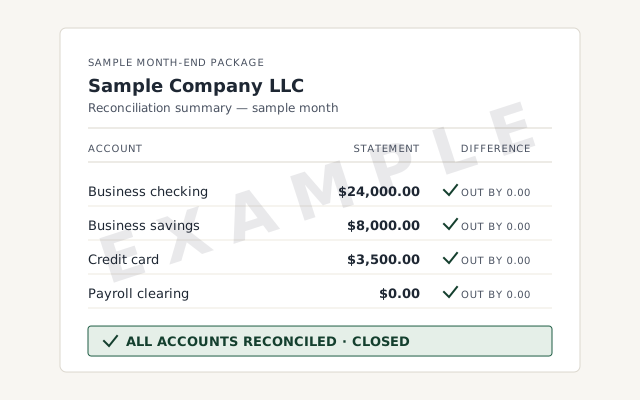 Sample workflow — not a specific client’s data
The production-after-split summary and reconciliation an agent client receives.
Getting payee and payment records right before year end is the same discipline everywhere — read how we do it.
Read the 1099 cleanup methodA written reply within one business day.
Remote-first, nationwide
Mon–Sat · 8am–6pm CT
We work entirely remote — view-only access for the free review, QuickBooks' accountant access for the work itself, screen-share whenever you want to watch, and every rebuilt closing and reconciled total recorded in writing.
The gross. A brokerage generally reports the full commission on a 1099-NEC before the split and fees it withheld, so gross is the figure that exists in the record about you. Booking only the deposit makes your income look smaller than what was reported, and it silently throws away the split and fees you were entitled to deduct — you end up paying for the brokerage's cut twice.
Because they are measuring different things and always will. The 1099 is the commission you earned; the deposit is what was left after the brokerage took its share. The gap between them is not an error, it is the split and the fees — and it only looks like an error when the books recorded the deposit and nothing else. Recorded properly, the two reconcile in a line or two.
It is the brokerage's statement for a closing, sometimes called a CDA or a commission statement, and it is the document your books should be built from. It shows the gross commission, the split, each fee withheld and the net paid to you — every number you need, laid out. Filing them as they arrive is the single habit that prevents rebuilding a year from bank deposits in February.
Each kind, on its own account. The brokerage's retained split, desk or office fees, per-transaction fees, technology or platform fees, franchise fees where they apply, and any referral paid out. They behave differently and they are negotiated differently, so a single 'brokerage expenses' line tells you nothing about which one grew. Agents who cannot say what their split costs them a year usually have exactly that one line.
It happens, and it is worth catching. If the form shows net, your income should still be recorded from the commission statements, and the discrepancy needs raising with the brokerage and with your CPA rather than quietly matching the wrong figure. Either way the CDA is the document that establishes what you actually earned, which is why keeping them matters beyond convenience.
No. What is reportable, how it is filed and how your income is treated on a return are matters for your CPA, and the brokerage owns what it reports. What we do is keep the books so the gross, the fees and the net all exist as separate, evidenced figures — which is what makes the return straightforward and a mismatch easy to explain instead of alarming.
Probably not as a bookkeeping engagement. An agent closing a handful of deals can keep this straight with the commission statements in a folder and a careful conversation with their CPA once a year. The work earns its fee when the deal count is high enough that reconstruction is painful, when there are referral payouts going out, or when a team has formed and other people are being paid.
Yes, because you are now on both sides of the arrangement. The commissions you receive still record gross, and the amounts you pay out to other agents become an expense tracked per person for year-end reporting purposes. That payout side is the brokerage's version of this problem and is covered on our real estate page; the agent side on this page still applies to your own production.
Yes, and it is usually where we start. Agents fall behind because closings are irregular, statements arrive by email and get buried, and nothing prompts a reconciliation until January. A catch-up rebuilds the year from the commission statements rather than the bank feed, so the gross is established from evidence and the fees land where they belong.
No. We keep the books — gross commission recorded, fees separated, the year reconciled to what the brokerage reported — so the file is accurate and current. Your CPA sets tax positions, advises on entity structure and files the return. Good bookkeeping makes that work faster and cheaper; it does not replace it.
Real estate splits into three different businesses in the books: QuickBooks for real estate covers owning property and paying agents out, QuickBooks for property management covers holding rent for other owners, 1099 cleanup handles the payee records behind any of them, and all industries lists the rest.
Not sure how bad it is?
Describe the file and a specialist will tell you which of these you are dealing with — including when the answer is that you don't need us.