Who’s responsible for your file
Your file is handled by Abid, Certified QuickBooks ProAdvisor — the same person through the review, the corrections and the hand-back.
About AbidQuickBooks for SaaS
Subscription bookkeeping turns on a distinction founders routinely collapse: MRR and ARR are billings metrics, recognized revenue is what you have earned by delivering. An annual contract adds to ARR the day it signs and to revenue one month at a time. We build the deferred revenue structure that keeps those numbers honest and separate.
QuickBooks for a subscription business means keeping two sets of numbers apart that everyone in the company is used to treating as one: what has been sold, and what has been earned.
The growth metrics a SaaS company runs on — MRR, ARR, net revenue retention — are contract metrics. They describe what customers have committed to. The financial statements describe something narrower: revenue earned by delivering service, period by period. Both are real, and a company that conflates them ends up with board reporting that does not reconcile to its own accounts, a deferred revenue balance nobody can defend, and an awkward conversation the first time an investor or an auditor asks how the two relate. Most SaaS files we see are not wrong through carelessness; they are wrong because the founder's instinct is that a signed contract is revenue, and in accounting terms it is not. This page is one industry lens on a full QuickBooks cleanup, pointed at a subscription business.
One contract produces three legitimate figures, and reporting becomes coherent only once the file names which is which.
A booking is the commitment — what the customer signed for, across whatever term the deal covers. A billing is the invoice — what you have actually asked them to pay, which for an annual-prepay deal is a year at a time and for a monthly plan is a month at a time. Recognized revenue is the earned portion — what the delivery of the service has converted into income for the period. A three-year deal, invoiced annually, delivered monthly, produces a large booking, a medium billing and a small monthly revenue figure, and every one of those is correct. The failure is not having three numbers; it is publishing one of them without saying which. When the board deck reports ARR and the financial statements report recognized revenue and nobody labels either, the two look like a contradiction rather than what they are.
An annual subscription paid up front puts cash in the bank and an obligation on the balance sheet — the unearned portion belongs in a deferred revenue account set up as an other current liability, and moves into income as the term is delivered.
One contract, three numbers
An annual subscription of 2,400.00 is signed and invoiced. The booking and the billing are both 2,400.00 in the month of signature. Recognized revenue for that month is 200.00, with 2,200.00 remaining in the deferred revenue liability. A confirmed panel notes that all three figures are correct at the same time and describe different things. Illustrative figures, not a client account.
Mechanically, the sale credits deferred revenue rather than income, and each period a journal entry debits deferred revenue and credits income for the portion earned. The balance that remains is a real, defensible number: it is what the business still owes in service. That matters beyond tidiness — it is the figure diligence tends to question first, because it is where an over-eager revenue policy shows up. QuickBooks Online's built-in revenue recognition can maintain that schedule from the product or service record itself, and that feature is part of the Advanced plan. On Plus and Essentials the schedule lives outside QuickBooks and is posted with recurring journal entries. Both get to the same accounts; the Advanced route simply removes the manual step.
ASC 606 frames revenue around a sequence: identify the contract, identify the performance obligations inside it, determine the price, allocate that price across the obligations, and recognize revenue as each obligation is satisfied.
For most straightforward subscriptions that sequence collapses into something simple — one obligation, delivered evenly across the term, recognized ratably. It stops being simple when a contract bundles things that are delivered on different clocks: a platform subscription plus an implementation project, or a licence plus a support agreement, or usage-based overage on top of a committed floor. Each of those may be a separate obligation with its own recognition pattern, and the allocation between them is a judgement rather than an arithmetic step. That judgement belongs to your CPA or auditor, and we do not make it. What we do is build the bookkeeping that carries their treatment faithfully — the accounts, the schedules, and a trail that shows how each contract was handled and why.
An upgrade, downgrade or cancellation part-way through a term changes what is left to deliver, so the deferred balance and the remaining monthly recognition both have to be recalculated from the change date forward.
The part that trips files up is that the already-delivered portion does not move. A customer six months into an annual plan who upgrades has consumed six months of the original contract; that revenue is earned and stays earned. What changes is the remaining obligation and the price attached to it, which means the schedule from the change date forward is a new calculation rather than a proportional tweak of the old one. A file that just overwrites the original schedule loses the history and, with it, the ability to explain why a given month recognized what it did. We rebuild the schedule forward and keep the prior version, so the trail survives. Where the receivable side has also drifted — invoices raised for changed terms, credits never applied — that is an accounts receivable cleanup alongside it.
How it starts
Every engagement opens with a free, view-only review. For a subscription business the review asks one question first: does the deferred revenue balance tie to the contracts behind it?
Day 0
We read the file view-only, test whether the deferred revenue balance reconciles to the outstanding contract terms, and check how billings metrics relate to the books.
Week 1
Deferred revenue set up as a liability, revenue lines separated by stream, and the chart of accounts arranged so billings and recognized revenue never share a line.
Weeks 1–3
Recognition schedules reconstructed per contract, including the ones already modified mid-term, and the historical deferred position corrected.
Ongoing
Each period the schedule is posted, the deferred balance is reconciled to remaining obligations, and the month-end package reports both numbers plainly.
Ongoing
A deferred revenue balance that can be defended line by line when an investor, a buyer or an auditor asks how it was built.
What changes
A subscription file built for the model reports what was earned and what is still owed. A generic one reports cash and calls it growth.
| Built for subscription | Generic setup | |
|---|---|---|
| Annual prepayments held as a liability | — | |
| Revenue recognized across the term | — | |
| Bookings and billings kept out of the revenue line | — | |
| Deferred balance reconciles to open contracts | — | |
| Mid-term changes rebuild the schedule forward | — | |
| Recognition trail survives the modification | — | |
| Board reporting reconciles to the accounts | — | |
| Verdict | A number diligence can follow | Cash mistaken for growth |
What it costs
Every engagement is a fixed scope with a fixed fee, quoted after a free view-only review. The figures below are published starting floors; the review sets the real range for your file.
| Engagement | Typical range | Timeline | What's included |
|---|---|---|---|
| SaaS cleanup | From $1,500 | 2–4 weeks | Rebuild deferred revenue and recognition schedules, separate billings from revenue, one entity. |
| Monthly bookkeeping | From $400/mo | Ongoing | Schedules posted, deferred balance reconciled to open contracts, month-end package. |
| Pre-diligence readiness | Custom fixed quote | Scoped first | A deferred revenue position documented contract by contract for an investor or buyer. |
| Get your range after a free review | |||
SaaS cleanup
Monthly bookkeeping
Pre-diligence readiness
One firm does the work — the same specialist start to finish — and the deferred revenue balance is treated as a number that has to survive a question, not a plug that makes the month close.
The method is verification rather than assertion: the deferred balance is reconciled against the contracts still to be delivered, so it can be defended line by line rather than accepted. Billings metrics and recognized revenue stay in separate, labelled places, because the fastest way to lose an investor's confidence is to hand over two numbers that disagree and be unable to say why. And we are explicit about the boundary — whether ASC 606 applies to you, how a bundled contract should be allocated, how a modification should be treated: those are your CPA's or auditor's calls. We build and document the bookkeeping that carries their treatment, and we do not quietly decide it for them.
Skip us when the billing model is simple enough that recognition is trivial, or when what you need is an auditor rather than a bookkeeper.
A company billing monthly in arrears, with no annual prepayments and no multi-element contracts, has almost nothing to defer — service delivered this month, invoiced this month, earned this month. Straightforward monthly bookkeeping covers it and the mechanics on this page barely apply. If you need an opinion on whether your revenue policy complies with a standard, that is an auditor's work and not ours; we can build the records that opinion will be formed on, but we cannot give it. And if your deferred revenue already reconciles to your open contracts each period, there is nothing here worth paying for. We will say so in the free review.
You do not have to take our word for it. Here is the evidence you can check — the deliverable you receive, the reference behind the method, and our response commitment.
Your file is handled by Abid, Certified QuickBooks ProAdvisor — the same person through the review, the corrections and the hand-back.
About Abid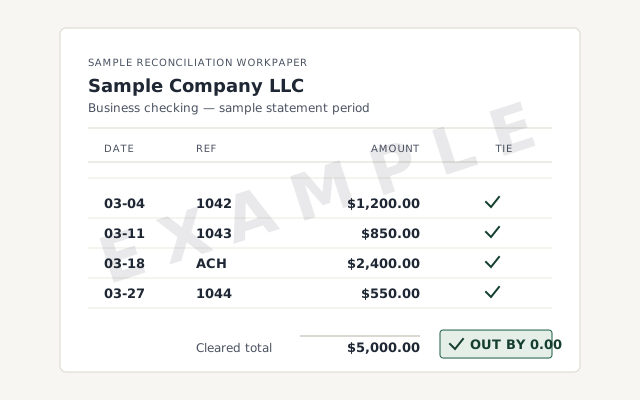 Sample workflow — not a specific client’s data
The sheet that ties a deferred revenue balance back to the contracts still to be delivered.
Recognition schedules are posted and proven at the close — read how a month-end close is run.
Read the month-end close methodA written reply within one business day.
Remote-first, nationwide
Mon–Sat · 8am–6pm CT
We work entirely remote — view-only access for the free review, QuickBooks' accountant access for the work itself, screen-share whenever you want to watch, and every recognition schedule documented against the contract behind it.
No, and treating them as the same is the most common reporting error in a subscription business. MRR and ARR are billings metrics — what is contracted and being invoiced. Recognized revenue is what has actually been earned by delivering the service. An annual contract signed today adds to ARR immediately and adds to recognized revenue only one month at a time.
Three different numbers from the same contract. A booking is what the customer committed to. A billing is what you invoiced them. Recognized revenue is what you have earned by delivering. A three-year deal invoiced annually and delivered monthly produces a large booking, a medium billing and a small monthly revenue figure — all correct, all different.
The invoice creates a receivable and the cash settles it, but the income does not land at once. The unearned portion sits in a deferred revenue account — an other current liability — and moves into revenue across the subscription term as the service is delivered. On day one you hold the cash and owe twelve months of service.
On QuickBooks Online Advanced, yes — revenue recognition schedules can be set on a product or service so the deferral and the periodic recognition are handled for you. On Plus and Essentials that automation is not available, so the schedule is maintained outside QuickBooks and posted with recurring journal entries. Both approaches are legitimate; only the amount of manual work differs.
ASC 606 is the revenue-recognition standard that frames revenue around identifying the contract, the performance obligations in it, the price, how that price is allocated, and recognizing revenue as each obligation is satisfied. Whether and how it applies to your company — and how a specific contract should be treated under it — is a question for your CPA or auditor. We build the bookkeeping that supports the treatment they set.
The remaining recognition schedule changes. Part of the original contract has already been delivered and recognized, and the modification changes what is left to deliver and at what price — so the deferred balance and the remaining monthly recognition both have to be recalculated from the change date forward. How a specific modification should be treated is a judgement your CPA sets; we implement and document it.
Usually because one is reading a billings metric and the other is reading recognized revenue. If the board deck reports ARR and the financial statements report recognized revenue, they will not agree and both can be right. The problem is only a problem when nobody says which number is which — which is why we keep them as separate, labelled lines rather than one figure.
In the books, yes. A cancellation stops future recognition and leaves a deferred balance that is either refunded or, depending on your terms, retained and recognized. The commercial policy is yours; the bookkeeping consequence is ours to record accurately so the liability reflects what you would actually owe if every customer left tomorrow.
We can get the bookkeeping ready: a defensible deferred revenue balance, recognition schedules that tie to contracts, and revenue lines that reconcile. What we do not do is give an audit opinion or advise on the raise. Diligence reads the books before it reads the deck, and a clean deferred revenue position is usually the first thing questioned.
Mostly Online, because subscription businesses tend to run there and because the revenue-recognition automation on the Advanced plan only exists in Online. Desktop files work too — the schedule is maintained and posted as journal entries. The accounting is identical either way; what changes is how much of it the software does for you.
The same unearned-revenue problem on a different clock: QuickBooks for gyms recognizes by use as well as by time, month-end close is where the schedules get posted, QuickBooks for ecommerce covers selling goods instead of subscriptions, and all industries lists the rest.
Not sure how bad it is?
Describe the file and a specialist will tell you which of these you are dealing with — including when the answer is that you don't need us.