Who’s responsible for your file
Your file is handled by Abid, Certified QuickBooks ProAdvisor — the same person through the review, the corrections and the hand-back.
About AbidQuickBooks for gyms and fitness
Gym bookkeeping turns on one fact: money collected for an annual membership or a session pack is not revenue yet. It is a liability until the service is delivered. Add platform settlements that bundle four kinds of income into one deposit, and a generic QuickBooks file reports a business that does not exist. We set that structure up and keep it current.
QuickBooks for a gym means building the file around a timing problem that most businesses never face: the money arrives long before the service is delivered, and the books have to keep those two facts apart.
A retailer sells a thing and earns the money the same day. A gym sells twelve months of access, or ten training sessions, and then owes that service for months afterwards. Every important number in a fitness business sits downstream of whether the file respects that gap — profit, margin by revenue line, and the liability the business is genuinely carrying if members walked in tomorrow and asked for what they paid for. Most gym files we see are not broken through carelessness; they are broken because generic bookkeeping habits record cash as revenue, and in this industry that is simply the wrong entry. This page is one industry lens on a full QuickBooks cleanup, pointed at a gym's books.
Money taken for a service you have not delivered is unearned revenue, and in QuickBooks it belongs in a deferred revenue account set up as an other current liability — then moved into income as the service is actually delivered.
The mechanism is a two-step one. The sale puts the cash in the bank and an equal amount into the deferred revenue liability, because at that moment the gym owes twelve months of access rather than owning twelve months of revenue. Each period, a journal entry debits deferred revenue and credits income for the portion genuinely earned, so the liability falls as the obligation is worked off. QuickBooks Online's built-in revenue recognition, which can run that schedule automatically from the product or service record, is available on the Advanced plan; on Plus and Essentials the schedule is maintained and posted as journal entries instead. Either route produces the same result — what differs is how much of it is manual.
Cash in January, revenue across the year
An annual membership of 1,200.00 is collected in January. The cash goes to the bank and an equal 1,200.00 goes to a deferred revenue liability, not to income. Each month a journal entry moves 100.00 from the liability into revenue, so after one month the liability stands at 1,100.00 and revenue for the month is 100.00. A confirmed panel notes that booking the whole amount as January income would overstate the month twelvefold. Illustrative figures, not a client account.
Session packs work on a different clock, and this is where gyms differ from every other subscription business. A membership is delivered by time, so it recognizes month by month whether or not the member turns up. A ten-session training pack is delivered by use, so it recognizes as sessions are actually taken — five sessions used is half the pack earned, regardless of how many months have passed. Running a pack on a time schedule reports revenue the gym has not earned and understates what it still owes. What happens to a pack that expires unused is a policy question for you and your CPA, and we record whichever position you take rather than choosing one.
A deposit from a booking or membership platform is rarely one kind of income: a single settlement can carry recurring membership dues, class-pack sales, personal training, retail purchases and processing fees netted against the total.
Posted as a lump sum, that deposit tells you nothing and reconciles to nothing. The gym cannot see whether training carries the business or the retail shelf earns its space, and the processing fees vanish into a net figure instead of appearing as the expense they are. The work is to take the settlement report the platform produces, split it back into the revenue lines it actually contains, record the fees gross as an expense, and reconcile the remainder to the deposit that hit the bank. We do not assert what any particular platform does or which reports it offers — those change, and naming a category is not the same as promising a feature. What stays constant is the target: each line to its own account, fees visible, and the settlement tying to the statement. This is the same class of work as our Square reconciliation and Stripe reconciliation, applied to a gym's mix of revenue.
Whether a trainer is an independent contractor or an employee changes everything downstream in QuickBooks, and the two cannot be run the same way without the payroll refusing to reconcile.
A contractor is paid as a vendor, accumulates toward a 1099, and carries no employer tax or withholding. An employee runs through payroll with withholding, employer taxes and liability accounts that have to clear. Those are different structures, different accounts and different year-end obligations — and a file where some trainers were set up one way and some the other, or where the same trainer moved between them, is one of the more common reasons a fitness payroll will not tie out. What we do not do is make the determination. How a working relationship should be classified depends on the substance of that relationship and it is a decision for you with your CPA or employment counsel. We record the classification you set, consistently, and we flag it plainly when the file shows the same person treated two ways. Where the payroll side is already tangled, that is a payroll cleanup.
Supplements, apparel and equipment are a retail business running inside a service business, and pooling them into one income account hides the margin on both.
Retail carries cost of goods sold and, if the gym holds stock, an inventory asset that has to be tracked and counted. Services carry no COGS at all — the cost of delivering a training session is labor, which sits elsewhere in the profit and loss. When both land in a single "sales" line, there is no way to read the gross margin on the retail shelf or to see what a membership is genuinely worth after the cost of delivering it. Separating them is a chart-of-accounts job rather than a clever report, which is why a gym file that has drifted usually needs a chart of accounts cleanup before the revenue lines mean anything.
How it starts
Every engagement opens with a free, view-only review. For a gym, the review is mostly about two questions: how much unearned revenue is the business actually carrying, and do the deposits tie.
Day 0
We read the file view-only, measure the deferred revenue position against what has actually been sold, and check whether platform settlements tie to the bank.
Week 1
Deferred revenue set up as a liability, retail separated from service income, fees broken out, and the chart of accounts grouped so margin is readable.
Weeks 1–2
Memberships and packs get recognition schedules — time-based for memberships, usage-based for packs — and the historical position is corrected.
Weeks 2–3
Platform deposits are split back into their revenue lines and reconciled to the statement, month by month, until the file ties.
Ongoing
A file that reports real revenue and a real liability — kept current each month if you want it kept, or handed back documented.
What changes
A gym file built for the industry separates cash from revenue and income line from income line. A generic one reports a business nobody would recognise.
| Built for a gym | Generic setup | |
|---|---|---|
| Prepaid memberships held as a liability | — | |
| Session packs recognized as used | — | |
| Platform settlements split by revenue line | — | |
| Processing fees visible as an expense | — | |
| Retail separated from service income | — | |
| Trainer classification recorded consistently | It depends | |
| Monthly revenue reflects service delivered | — | |
| Verdict | A real picture of the business | A January that never happened |
What it costs
Every engagement is a fixed scope with a fixed fee, quoted after a free view-only review. The figures below are published starting floors; the review sets the real range for your file.
| Engagement | Typical range | Timeline | What's included |
|---|---|---|---|
| Gym cleanup | From $1,500 | 2–4 weeks | Rebuild the deferred revenue position, split historical settlements, separate retail from service. |
| Monthly bookkeeping | From $400/mo | Ongoing | Settlements reconciled, recognition schedules run, month-end package each period. |
| Multi-location | Custom fixed quote | Scoped first | More than one site, or a franchise arrangement with its own reporting. |
| Get your range after a free review | |||
Gym cleanup
Monthly bookkeeping
Multi-location
One firm does the work — the same specialist on your file start to finish — and the deferred revenue position is treated as a real number you can be asked about, not a plug that makes the month look tidy.
The method is verification rather than assertion. The liability the gym carries is reconciled against what has actually been sold and delivered, so the balance can be defended rather than assumed. Settlements are split from the reports your platform genuinely produces, not from what we assume it offers. And where a decision is not ours — trainer classification, the treatment of expired packages, any tax position — we say so and record what you and your CPA decide rather than quietly choosing. Access stays minimal: view-only for the free review, QuickBooks' accountant access for the work, never your bank or platform logins.
Skip us when the studio is small enough that the timing problem barely exists, or when what you actually need is a booking platform rather than a bookkeeper.
A single-trainer studio billing month to month, with no annual memberships and no packs sold in advance, has very little deferred revenue to manage — the mechanics on this page mostly do not apply, and a straightforward monthly bookkeeping arrangement is enough. If your real problem is that you cannot see who has sessions remaining, that is a scheduling and membership-management question your platform answers, not something a QuickBooks file should be asked to solve. And if your books are already structured this way and reconciling each month, there is nothing here to buy. We will tell you which case you are in during the free review, including when the answer is that you do not need us.
You do not have to take our word for it. Here is the evidence you can check — the deliverable you receive, the reference behind the method, and our response commitment.
Your file is handled by Abid, Certified QuickBooks ProAdvisor — the same person through the review, the corrections and the hand-back.
About Abid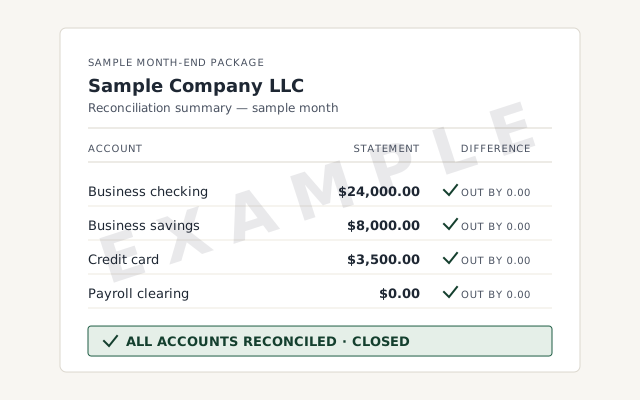 Sample workflow — not a specific client’s data
The reconciliation summary and revenue-by-line report a monthly gym client receives.
Splitting a processor settlement back into its parts is the same discipline everywhere — read how we do it.
Read the Square reconciliation methodA written reply within one business day.
Remote-first, nationwide
Mon–Sat · 8am–6pm CT
We work entirely remote — view-only access for the free review, QuickBooks' accountant access for the work itself, screen-share whenever you want to watch, and every recognition schedule and settlement split recorded in writing.
As a liability first, not income. Cash collected for services you have not delivered yet is unearned, so it goes to a deferred revenue account — an other current liability — and is moved into income as each month of membership is actually delivered. The cash is yours on day one; the revenue is not.
Because annual memberships and pre-paid packages sold in the New Year rush were probably booked as income the day the money arrived. That reports a full year of service as one month of revenue, overstates profit for the period, and pulls tax forward on money you have not yet earned. Spreading it across the term the membership actually covers is what fixes it.
A membership is delivered by time, so it is recognized month by month across the term. A session pack is delivered by use, so it is recognized as sessions are actually taken — five of ten sessions used means half the pack has been earned regardless of how many months have passed. Packs that expire unused need their own treatment, which is a policy question for you and your CPA.
A platform settlement is almost never one kind of income. A single deposit can carry membership dues, class-pack sales, personal training, retail and processing fees netted against the total. It has to be split back into those revenue lines with the fees broken out as an expense, or the deposit will never tie to the bank and the profit-and-loss will not show which part of the business earns.
No. Booking and POS platforms change their features and their exports constantly, so we do not claim what any given system does. We work from the settlement reports your platform actually produces, map each line to the right account, and reconcile the result to the bank. What matters is the structure the numbers land in, which is ours to get right.
That determination is not a bookkeeping decision and we do not make it. It depends on how the working relationship is actually structured, and the answer comes from you with your CPA or employment counsel. What we do is record whichever classification you have set correctly and consistently — because the two run through QuickBooks completely differently, and mixing them is a common source of payroll that will not reconcile.
No. Retail and services are different businesses inside one gym: retail carries cost of goods sold and inventory, services do not. Pooling them into a single income line hides the margin on both, so you cannot see whether the retail shelf earns its space or what a membership is really worth.
Yes, and it is often where we start. Gyms fall behind quickly because the transaction volume is high and the platform deposits are relentless. A catch-up reconciles the settlements, separates the revenue lines, and rebuilds the deferred revenue position so the balance reflects what is genuinely still owed in service.
No. We keep the books — deferred revenue, payout splits, the chart of accounts — so the file is accurate and current. Your CPA sets tax positions, decides how unused package balances are treated, and files returns. Good bookkeeping makes that work faster; it does not replace it.
Both. Most studios run QuickBooks Online because it connects more easily to booking platforms and payroll; some larger operations are on Desktop or Enterprise. The mechanics are the same in either — a deferred revenue liability, split settlements, separated retail and service income. Only the menus and the integration path differ.
The same timing problem shows up elsewhere: QuickBooks for SaaS handles it on a subscription clock, month-end close is where the schedules get run, QuickBooks for restaurants splits the same platform settlements, and all industries lists the rest.
Not sure how bad it is?
Describe the file and a specialist will tell you which of these you are dealing with — including when the answer is that you don't need us.