Who’s responsible for your file
Your file is handled by Abid, Certified QuickBooks ProAdvisor — the same person through the review, the corrections and the hand-back.
About AbidQuickBooks for agencies
An agency that bills a client's media budget and a fee on top can legitimately report either the whole budget as revenue or only the fee — and in QuickBooks that choice is a checkbox, not an accounting exercise. Most agency files were never asked the question, so the top line means one thing in one year and something else in the next. We make it deliberate and keep it consistent.
QuickBooks for an agency means deciding, deliberately, whose money the money is — because a large share of what passes through an agency's bank account was never the agency's to earn.
Media budgets, print and production runs, freelance and contractor invoices, stock licences, ad platform spend: an agency lays out cost on a client's behalf and recovers it, sometimes at cost and sometimes with a margin. That flow is the defining feature of the business model and the reason two agencies with identical profit can report revenue an order of magnitude apart. Everything downstream — what your top line means, whether you can see profit per client, what a lender or a buyer is looking at — sits on how the file treats that pass-through. Most agency books we see are not wrong so much as undecided. This page is one industry lens on a full QuickBooks cleanup, pointed at an agency's books.
QuickBooks records a reimbursed cost one of two ways, and the choice is made by a single setting: the reimbursement either posts as income alongside the expense, or posts back against the expense account as though the cost had never been incurred.
Same year, same work, two revenue figures
An agency bills 400,000 in fees and passes through 2,000,000 of client media spend. With billable expenses tracked as income, reported revenue is 2,400,000 and expenses carry the matching 2,000,000. With the setting off, the reimbursement posts back against the expense and reported revenue is 400,000. A confirmed panel notes that profit is identical either way, and that the danger is a file that has used both treatments in different periods. Illustrative figures, not a real agency.
In QuickBooks Online the control sits under the gear icon, in Account and settings, on the Expenses tab, in the Bills and expenses section — the option reads "Track billable expenses and items as income." Turning it on offers a further choice: track everything in a single account, which QuickBooks names Billable Expense Income, or track across multiple accounts, which adds a checkbox to each income account so you can mark the ones eligible to receive billable expense income. Left off, a reimbursement posts back to the expense account it came from, and that expense reads as though the agency never incurred the cost at all.
Gross and net are both legitimate presentations of the same transactions, and choosing between them is a reporting decision for you and your CPA rather than a bookkeeping preference we impose.
What is genuinely broken is the third state, and it is the one we find most often: a file where the setting was flipped at some point, or where some pass-through was grossed up and some was quietly netted because different people entered it differently. Then no period compares to any other. Growth that looks like forty percent is a change in accounting treatment. A lender comparing two years is comparing two different definitions. A buyer running diligence finds the revenue line moves when nothing about the business did, and everything else in the file becomes suspect by association. The fix is not to pick the flattering answer — it is to pick one, apply it across the whole history, and document when and why it was set, so the number means the same thing every time someone reads it.
Whichever treatment you choose, agency fee income and reimbursed client cost need their own accounts, because they answer different questions and carry completely different margins.
Fee income is what the agency earned for its work and is the number that actually scales with headcount, capability and rate. Pass-through is money moving through the business, and its margin is either zero or a thin handling percentage. Blended into one revenue line, a growing media budget looks like a growing agency, and a client who spends heavily looks more valuable than one who pays well for strategy. Separating them costs nothing and changes what management can see: revenue per head becomes meaningful, the fee line becomes comparable across clients, and the pass-through line becomes something you can watch for the working-capital risk it actually is. This is a chart of accounts decision made once, and every report afterwards depends on it.
An agency's real management question is not what the business earned in total but which clients and which projects earned it, and QuickBooks can answer that when cost is attributed at entry rather than reconstructed later.
Income and cost can both be attached to a customer, which gives profitability per client directly. Class or location tracking adds a second axis — service line, office, brand — so a project can be read across both. What makes it work is not the feature but the discipline: every vendor bill, every freelance invoice, every ad platform charge tagged to the client it belongs to at the moment it is entered. Reconstructed at quarter-end from memory and email, the attribution is a guess, and a guessed margin is worse than no margin because it gets acted on. Where an agency wants that second axis switched on properly, that is a class tracking setup.
How it starts
Every engagement opens with a free, view-only review. For an agency, the review asks one question first: does your revenue line mean the same thing in every period?
Day 0
We read the file view-only, check how billable expenses are set and whether that treatment held across the whole period, and test whether cost is attributed to clients at all.
Week 1
You and your CPA decide gross or net; we set it, document the decision, and separate fee income from pass-through into their own accounts.
Weeks 1–3
Prior periods brought onto the chosen treatment consistently, reimbursements applied to the costs they actually covered, and mixed entries corrected.
Weeks 3–4
Cost tagged to clients and projects where the records support it, retainer positions rebuilt, and everything reconciled to the bank.
Ongoing
Pass-through tagged as it is entered, retainers released as work is delivered, and a month-end package that reports fee income and pass-through apart.
What changes
An agency file built for the model reports a top line that means one thing and a margin you can act on. A generic one reports a number that moves for reasons nobody can explain.
| Built for an agency | Generic setup | |
|---|---|---|
| Pass-through treatment chosen deliberately | — | |
| Same treatment across every period | — | |
| Fee income on its own line | — | |
| Reimbursed cost traceable to the client | — | |
| Retainers held as a liability until earned | It depends | |
| Profit readable per client | — | |
| Revenue comparable year over year | — | |
| Verdict | A top line you can defend | A number that moves on its own |
What it costs
Every engagement is a fixed scope with a fixed fee, quoted after a free view-only review. The figures below are published starting floors; the review sets the real range for your file.
| Engagement | Typical range | Timeline | What's included |
|---|---|---|---|
| Agency cleanup | From $1,500 | 2–4 weeks | Settle the pass-through treatment, rebuild prior periods onto it, separate fee income, attribute cost to clients. |
| Monthly bookkeeping | From $400/mo | Ongoing | Pass-through tagged at entry, retainers released as earned, month-end package each period. |
| Multi-entity | Custom fixed quote | Scoped first | More than one entity, or several offices and service lines needing separate reporting. |
| Get your range after a free review | |||
Agency cleanup
Monthly bookkeeping
Multi-entity
One firm does the work — the same specialist start to finish — and the pass-through question gets asked out loud at the start instead of being inherited from whatever the file was left on.
The method is verification rather than assertion: reimbursements are matched to the costs they actually covered, so the pass-through line can be defended rather than assumed, and client attribution comes from the records rather than from reconstruction. Where the records cannot establish which client a historical cost belonged to, it goes on a list for you instead of being spread to make a margin look plausible. And we hold the boundary at the reporting decision itself: gross versus net is yours with your CPA, and our job is to apply it consistently and document when it was set. Access stays minimal: view-only for the free review, QuickBooks' accountant access for the work, never your bank or ad platform logins.
Skip us when you bill fees only, or when what you actually need is project management software rather than a bookkeeper.
An agency that invoices for its own time and passes nothing through has no gross-versus-net problem at all — the mechanics on this page barely apply, and ordinary monthly bookkeeping serves you better. If the real complaint is that you cannot see who is working on what, how many hours a project consumed, or whether a scope is running over, that is a time-tracking and project-management question your production system answers; a QuickBooks file reports the money afterwards and should not be asked to run the studio. And if your books already separate fee from pass-through, hold one treatment consistently and attribute cost per client, there is nothing here to buy. The free review will tell you which case you are in, including when the answer is that you do not need us.
You do not have to take our word for it. Here is the evidence you can check — the deliverable you receive, the reference behind the method, and our response commitment.
Your file is handled by Abid, Certified QuickBooks ProAdvisor — the same person through the review, the corrections and the hand-back.
About Abid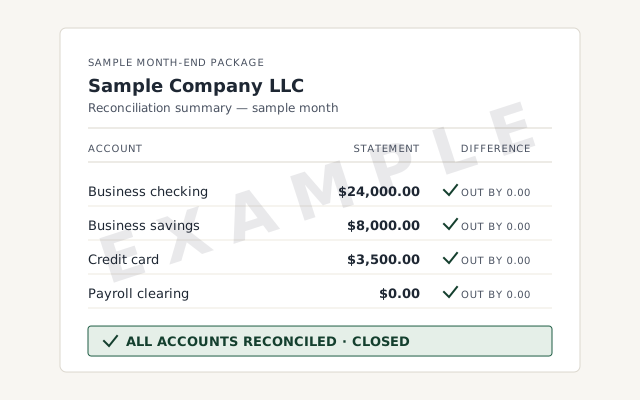 Sample workflow — not a specific client’s data
The reconciliation summary and fee-versus-pass-through report a monthly agency client receives.
Deciding what belongs in which account before anything else is the whole discipline — read how we do it.
Read the chart of accounts methodA written reply within one business day.
Remote-first, nationwide
Mon–Sat · 8am–6pm CT
We work entirely remote — view-only access for the free review, QuickBooks' accountant access for the work itself, screen-share whenever you want to watch, and the pass-through treatment and every reclassified cost recorded in writing.
It depends on a setting, which is exactly the problem. QuickBooks lets you record a reimbursed cost either as income or as a reduction of the expense. Recorded as income, a year of pass-through media appears in your top line; recorded against the expense, it does not appear at all. Both are legitimate presentations of the same underlying transactions — but they produce revenue figures that can differ by a multiple, so the choice has to be deliberate and consistent, not whatever the file was left on.
It is the income side of a reimbursed cost. When the billable-expense setting is on, a cost you incur on a client's behalf posts to your expense account, and the reimbursement posts as income — so the profit and loss shows both, grossed up, netting to roughly zero on that transaction. With the setting off, the reimbursement posts back against the expense account instead, and the expense reads as though you never incurred it.
In QuickBooks Online it sits under the gear icon, in Account and settings, on the Expenses tab, in the Bills and expenses section — the option is 'Track billable expenses and items as income'. Turning it on offers a further choice between tracking everything in a single account, which QuickBooks names Billable Expense Income, or across multiple accounts, which adds a checkbox to each income account so you can mark which ones may receive billable expense income.
That is a reporting decision for you and your CPA, and it usually follows how you talk about the business to lenders, investors or a buyer. What we will say plainly is that the wrong failure mode is not choosing either one — it is a file where the setting changed part-way through, or where some pass-through was grossed up and some was netted, so no year compares to any other. We set whichever position you take and apply it consistently across the whole file.
Most often because pass-through cost is grossed up into revenue and nobody flagged it. An agency that bills a large media budget and a modest fee will report the whole budget as revenue under one treatment and only the fee under the other. Neither figure is wrong; reading the first one as though it were the second is what causes the shock. Separating fee income from billable expense income into their own lines is what makes the top line legible again.
Yes, and for most agencies it matters more than the top line. QuickBooks can attribute income and cost to a customer, and class or location tracking adds a second axis for offices, service lines or brands. What makes it work is discipline at entry — every cost tagged when it is recorded, not reconstructed at quarter-end — and a chart of accounts that separates fee income, pass-through, and internal overhead in the first place.
A retainer collected before work is done is unearned, so it sits as a liability and moves into income as the work is delivered. The mechanics are the same as any advance payment. Where it gets specific to agencies is that a retainer is often part fee and part budget for pass-through spend, and those two components behave differently — so a retainer that is not broken into its parts will misstate both revenue and the cost sitting against it.
No. What you charge, how you structure a scope, and what your client agreements say are yours. We record what actually happened — what was billed, what was spent on whose behalf, what was reimbursed, and what is outstanding — so that the reporting reflects your commercial arrangements rather than reshaping them.
Yes, and it is often where we start. Agencies fall behind because pass-through volume is high, cost arrives from many vendors on many cycles, and the person who knows which client a charge belonged to is usually the busiest person in the building. A catch-up attributes the costs, applies the reimbursements, and rebuilds a top line that means one thing throughout the period.
No. We keep the books — the pass-through treatment, the client attribution, the retainer position — so the file is accurate and current. Your CPA sets the reporting and tax positions, including the gross-versus-net question itself, and files returns. Good bookkeeping makes that work faster; it does not replace it.
Money that passes through a business is a recurring problem: QuickBooks for salons asks whose revenue a ticket is, QuickBooks for auto repair bills sublet work through at cost, class tracking setup is how profit gets read per client, and all industries lists the rest.
Not sure how bad it is?
Describe the file and a specialist will tell you which of these you are dealing with — including when the answer is that you don't need us.