Who’s responsible for your file
Your file is handled by Abid, Certified QuickBooks ProAdvisor — the same person through the review, the corrections and the hand-back.
About AbidQuickBooks for childcare
Childcare bookkeeping turns on a split most businesses never face: one tuition charge is paid partly by a state subsidy agency and partly by the family, on two completely different schedules. The books have to track both sides of the same charge, per family and per agency, or the receivable stops meaning anything.
QuickBooks for a childcare center means building the file around a fact that generic bookkeeping has no concept of: a single tuition charge is frequently owed by two different parties at once.
In most businesses, one invoice has one customer. In childcare, a child's weekly tuition can be split between a state or county subsidy program — paid on the agency's schedule, after the agency's own approval and documentation process — and a copay owed by the family on the center's terms. Those two portions are the same charge, but they behave nothing alike: different amounts, different timing, different chasing, different paperwork. A file set up the ordinary way records whichever payment happens to arrive and quietly loses the other half. This page is one industry lens on a full QuickBooks cleanup, pointed at a center's books.
The structure that makes childcare receivables work is recording the full tuition charge once, then splitting it into the agency portion and the family copay as separate lines against that same charge.
One charge, two payers, two clocks
A weekly tuition charge of 300.00 splits into a subsidy agency portion of 220.00 and a family copay of 80.00. The two portions are tracked separately: the agency balance ages on the agency's own remittance schedule, the family balance on the center's terms. A confirmed panel shows the full charge visible and each payer tracked to whoever owes it. Illustrative figures, not a real center.
Recording it as one charge with two payer lines keeps three things true at once. The full value of the enrollment is visible, so the center can see what a place is actually worth rather than only what the family paid. Each payer's share is attributed to the party that owes it, so a chase can be aimed at the right place. And when the agency remits — often for several children at once, often weeks later, often net of adjustments — that remittance can be applied against the specific charges it covers instead of landing as an unexplained lump of income.
Family balances and agency balances age on unrelated schedules, so a childcare receivable only means something when the two are tracked apart.
A family copay is due on the center's terms — weekly, monthly, whatever the enrollment agreement says — and a balance that slips past those terms is a collections question with a parent. An agency balance is different in kind: it is outstanding because the agency's approval, attendance documentation and payment cycle have not yet completed, and thirty days may be entirely normal rather than late. Pooling both into one aging report produces a number that describes neither situation. The center cannot tell whether it has a collections problem with families or simply a slow remittance cycle, and the two call for completely different responses. Where a file has already pooled them for years, untangling it is an accounts receivable cleanup with a childcare-specific shape.
Subsidy funding and private-pay tuition are different revenue streams, and a center that reports them on one line cannot answer the question every owner, lender and board eventually asks.
That question is simple: how much of this center depends on agency funding? A single tuition income line makes it unanswerable without rebuilding a year by hand. Separating the streams also surfaces something operationally useful — the two behave differently under stress, because a policy change at a funding agency hits one and not the other. Beyond the payer split, most centers carry several revenue lines that deserve their own accounts: registration fees, late-pickup fees, supply or activity fees, and often a summer or holiday program running on quite different economics from the school year. Pooling those into tuition hides which programs contribute and which merely occupy staff. Getting the structure right is a chart of accounts job, done once, that every later report depends on.
Bookkeeping records what happened; it does not run a center's funding relationships, and we are explicit about that line.
Submitting subsidy claims, meeting an agency's documentation and attendance requirements, resolving a disputed payment, and maintaining licensing compliance all stay with the center. Those run through relationships and rules we are not party to. What we own is the record: what was billed, how it was split, what each payer actually paid, what remains outstanding from whom, and whether the totals reconcile to the bank. Where a center participates in a food program, the reimbursement is tracked against the attendance and meal counts it rests on and kept apart from tuition, so the claim stays traceable — but the claim itself, and its substantiation to the program, remain the center's. Payroll is its own discipline in a center with rotating staff and ratio requirements; where that side has drifted it is a payroll cleanup rather than something folded in quietly.
How it starts
Every engagement opens with a free, view-only review. For a center the review asks one question first: can you tell what each family owes and what each agency owes, separately?
Day 0
We read the file view-only and test whether split charges exist at all, whether agency remittances tie to what was billed, and how far the receivable has drifted.
Week 1
Tuition set up as one charge with agency and family portions tracked separately, and revenue lines split by payer stream and program.
Weeks 1–3
Historical charges re-split where the records support it, agency remittances applied against the charges they actually covered, and family balances separated out.
Weeks 3–4
Both receivables reconciled to the bank, a written record of every re-split, and a call to walk it through.
Ongoing
Charges split as they are billed, remittances applied as they arrive, and a month-end package that reports both payer streams plainly.
What changes
A center's file built for the industry can answer who owes what and which stream funds the place. A generic one records whichever payment happened to arrive.
| Built for a center | Generic setup | |
|---|---|---|
| Full tuition charge visible | — | |
| Agency and family portions split on one charge | — | |
| Receivable tracked per family | It depends | |
| Receivable tracked per agency | — | |
| Subsidy and private-pay reported separately | — | |
| Registration and fee income on their own lines | — | |
| Remittances applied to the charges they covered | — | |
| Verdict | You know who owes what | Half the revenue invisible |
What it costs
Every engagement is a fixed scope with a fixed fee, quoted after a free view-only review. The figures below are published starting floors; the review sets the real range for your file.
| Engagement | Typical range | Timeline | What's included |
|---|---|---|---|
| Childcare cleanup | From $1,500 | 2–4 weeks | Rebuild split charges, apply agency remittances, separate family and agency receivables, one center. |
| Monthly bookkeeping | From $400/mo | Ongoing | Charges split as billed, remittances applied, both payer streams reported each month. |
| Multi-site | Custom fixed quote | Scoped first | More than one location, or several funding programs with different reporting. |
| Get your range after a free review | |||
Childcare cleanup
Monthly bookkeeping
Multi-site
One firm does the work — the same specialist start to finish — and the receivable is rebuilt so it answers the two questions a center actually has, rather than averaging them into one.
The method is verification rather than assertion: agency remittances are matched against the charges they actually covered, so an agency balance can be defended rather than assumed, and a family balance means a family genuinely owes it. Where the records cannot establish which charges a remittance covered, that lands on a list for the center rather than being spread across balances to make a total work. And we hold the boundary at the center's funding relationships — we do not submit claims, chase an agency, or advise on licensing. Access stays minimal: view-only for the free review, QuickBooks' accountant access for the work, never your bank logins, and no access to child or family records beyond the billing information already in the accounting file.
Skip us when the center is fully private-pay and small, or when the real problem is billing software rather than bookkeeping.
A small, entirely private-pay center has no split-payer problem at all — the distinctive mechanics on this page simply do not apply, and ordinary monthly bookkeeping is enough. If what you actually need is a system that bills families, tracks attendance and produces agency claims, that is childcare management software, not a QuickBooks file; we work alongside those systems rather than replacing them, and we will say so rather than sell you a cleanup that does not address the complaint. And if your center already splits charges, tracks both receivables separately and reconciles each month, there is nothing here to buy. The free review will tell you which case you are in, including when the answer is that you do not need us.
You do not have to take our word for it. Here is the evidence you can check — the deliverable you receive, the reference behind the method, and our response commitment.
Your file is handled by Abid, Certified QuickBooks ProAdvisor — the same person through the review, the corrections and the hand-back.
About Abid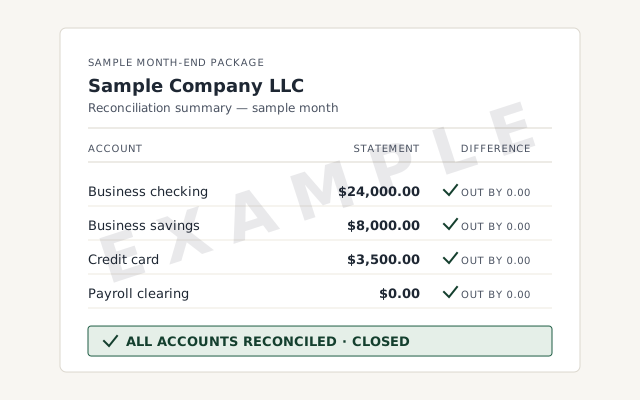 Sample workflow — not a specific client’s data
The reconciliation summary and payer-stream report a monthly center client receives.
Splitting a tangled receivable back into real balances is the same discipline everywhere — read how we do it.
Read the A/R cleanup methodA written reply within one business day.
Remote-first, nationwide
Mon–Sat · 8am–6pm CT
We work entirely remote — view-only access for the free review, QuickBooks' accountant access for the work itself, screen-share whenever you want to watch, and every re-split charge and applied remittance recorded in writing.
As one charge with two payers, not two unrelated transactions. The agency portion and the family copay are recorded as separate lines against the same tuition charge, so the full fee is visible and each payer's share is tracked to whoever owes it. Recording only the agency payment, or only the copay, leaves half the revenue invisible.
Because two payers on one charge age on completely different clocks. A family copay is due on your terms; an agency pays on its own schedule after its own approval and documentation process. Pooled into a single receivable, the report averages two unrelated timelines and tells you nothing useful about either.
Yes, and this is the piece generic setups miss. You need to know what each family owes and, separately, what each funding agency owes — because the agency balance is chased differently, with different paperwork and a different contact. One pooled receivable makes both untrackable.
They should be separate revenue lines, yes. Private-pay and subsidy are different revenue streams with different reliability, different timing and often different reporting obligations. Mashed into a single tuition line, you lose the ability to see what share of the center depends on agency funding — which is usually the first thing an owner, a lender or a board wants to know.
Beyond tuition, most centers carry registration fees, late-pickup fees, supply or activity fees, and often a summer camp or holiday program that runs on its own economics. Each deserves its own line, because they behave differently and pooling them hides which programs actually contribute.
Where a center participates in a food program, the reimbursement is tracked against the attendance and meal counts it is based on, and kept apart from tuition revenue. It is a distinct funding stream with its own records, and the substantiation matters — so the bookkeeping has to make the claim traceable rather than folding it into a general income line.
No. Submitting claims, meeting agency documentation requirements and resolving payment disputes stay with the center — those run through your licensing and funding relationships, not your books. What we do is record what was billed, what each payer actually paid, and what is still outstanding from whom, so you can see the position clearly.
Partly. A fully private-pay center does not have the split-payer problem, but the rest still applies — separate revenue lines by program, fees kept out of tuition, and receivables tracked per family. The mechanics on this page are most valuable when agency funding is in the mix; the free review will tell you honestly how much of it is relevant to you.
Yes, and it is often where we start. Centers fall behind because the billing is high-frequency and the agency remittances arrive irregularly. A catch-up rebuilds the split charges, reconciles what each agency actually paid against what was billed, and restores a receivable you can work from.
No. We keep the books — the split charges, the payer streams, the receivables — so the file is accurate and current. Your CPA sets tax positions, handles any nonprofit or entity-specific reporting, and files returns. Good bookkeeping makes that work faster; it does not replace it.
A split receivable is a cleanup problem first: the A/R cleanup that untangles it, the payroll cleanup for a rotating staff roster, or all industries for the rest.
Not sure how bad it is?
Describe the file and a specialist will tell you which of these you are dealing with — including when the answer is that you don't need us.