Who’s responsible for your file
Your file is handled by Abid, Certified QuickBooks ProAdvisor — the same person through the review, the corrections and the hand-back.
About AbidQuickBooks for breweries
Beer is taxed when it leaves the brewery, not when a customer buys it. Federal excise is determined on removal for consumption or sale, which makes it a liability driven by production and movement rather than a tax collected at the till. Most brewery files never record it that way.
QuickBooks for a brewery means running a manufacturing ledger and a regulated-quantity record in the same file, and keeping both honest about the beer.
Most small businesses have one question about tax: what did we sell and what do we owe on it. A brewery has a different one, because its largest tax obligation is triggered by an operational event rather than a commercial one, and because a federal regulator expects the brewery's own records to prove what was produced and what left. That means the file has to carry quantities as well as money, and the two views have to agree. Underneath that sits ordinary manufacturing accounting, which most brewery files also lack. This page is one industry lens on a full QuickBooks cleanup, pointed at a brewery's books.
TTB states that taxes on beer are determined when the products are removed from the brewery premises for consumption or sale — so the obligation attaches to a physical movement rather than to a transaction with a customer.
What triggers the liability
Beer held in the cellar carries no determined tax. Beer removed for consumption or sale — moved to the taproom or shipped to a distributor — is a taxable removal and accrues an excise liability. Beer returned to the brewery in the same return period reduces removals to arrive at net taxable removals. A confirmed panel notes that a sale to a customer is a separate event and does not trigger the tax. Illustrative structure, no rates shown.
Two consequences follow, and both are structural. First, excise is a liability of the brewery rather than money collected from anybody — unlike sales tax, which a business holds on a customer's behalf and passes on. Booking excise as though it were a sales tax puts it in the wrong account, driven by the wrong record, and reconciles against the wrong thing. Second, because the amount is a function of quantity removed rather than of revenue, the entry cannot be derived from a percentage of sales. It has to be built from the removal records. TTB also describes the tax for a return period as resting on net taxable removals — removals for consumption or sale, less beer returned to the brewery within that same period — so a file that captures shipments but never captures returns will accrue more than is owed. Rates, reduced rates, thresholds and filing frequency are TTB's to set and yours to confirm with them and your CPA; we do not state them, and we build the structure that carries whatever they turn out to be. Where the sales-tax side of the taproom has separately drifted, that is a sales tax cleanup and a genuinely different problem.
A brewery keeps at least three views of the same activity — the daily production and removal records, what it reports to its regulator, and the accounting file — and if they disagree, one of them is wrong.
TTB's published findings from brewery audits are unusually clear about where the weakness sits. The most frequently cited problem is not miscalculation but records: a lack of, or inaccuracy in, the records the regulations require. The specific events it names as most commonly mishandled are beer returned to the brewery, destructions, and losses or shortages. That list is not random — those are precisely the events with no invoice, no customer and no payment attached, so nothing in an ordinary bookkeeping workflow prompts anyone to record them. A keg that comes back, a batch dumped after a failed QA check, and a shortfall discovered at a physical count all move quantity without moving money, and a file built only around transactions will never see them. Our part is to make sure the accounting record reflects the same reality as the operational one, so that a physical count, what you reported, and what the books say can be laid alongside each other and agree. We do not prepare the operational reports or the excise returns; we make sure the file does not contradict them.
Grain, hops, yeast and packaging are raw materials; beer in fermenters and conditioning tanks is work in process; packaged kegs and cans are finished goods — and cost moves through those stages rather than hitting expense when an invoice arrives.
Most brewery files we see expense ingredients and packaging on the purchase date, which is simple, wrong, and quietly destroys every question worth asking. A brewery on that basis cannot say what a batch cost, cannot value the cellar, and reports a profit that swings with purchasing rather than with production — a big grain delivery makes a bad month and a quiet purchasing month makes a good one, regardless of how much beer was brewed or sold. The correct structure holds cost in inventory as it moves through the stages and releases it to cost of goods sold when the finished beer is sold. It is more work at setup and it is the only way the numbers describe the brewery. Where an existing file has stock recorded but drifting from what is physically there, the fix is a recount and recost rather than a structural change, which is an inventory cleanup in its own right.
Serving a pint across a bar and selling a pallet to a distributor are different businesses with different margins, different terms and different tax treatments, and pooling them into one sales account hides both.
The taproom is retail: high margin per unit, immediate payment, its own sales tax treatment, and usually food, merchandise and guest taps alongside the brewery's own beer. Wholesale moves volume at a lower price, on terms, with receivables to chase and often distributor programmes affecting the net. Both draw on the same production, which makes the comparison meaningful and the pooling tempting. Separated, a brewery can see what a barrel earns through each channel and decide where capacity should go — the actual strategic question in the industry. The taproom side also carries the daily-sales mechanics of any hospitality business, which our restaurants page covers in full; what is specific here is that beer moved to the taproom is itself a removal, so the channel split and the excise record are two views of the same event.
How it starts
Every engagement opens with a free, view-only review. For a brewery the review asks one question first: does the accounting file agree with what you reported?
Day 0
We read the file view-only, check whether excise sits as a liability or as a tax, and compare a period's recorded activity against what the operational records show.
Week 1
Excise established as an accrued liability driven by removals, taproom and wholesale separated, and inventory stages set up for a manufacturer.
Weeks 1–3
Prior periods reclassified where the records support it, ingredient and packaging cost moved into inventory, and returns and destructions captured.
Weeks 3–4
The accounting record reconciled against physical counts and against what was reported, with anything unexplained listed for you rather than absorbed.
Ongoing
Removals accrued, returns netted, inventory stages maintained, and a month-end package that shows margin by channel and the liability actually carried.
What changes
A brewery file built for the industry agrees with the cellar and with what was reported. A generic one describes a shop that happens to buy a lot of grain.
| Built for a brewery | Generic setup | |
|---|---|---|
| Excise carried as an accrued liability | — | |
| Liability driven by removals, not by sales | — | |
| Returns netted within the period | — | |
| Destructions and losses recorded | — | |
| Raw materials, WIP and finished goods separated | — | |
| Batch cost knowable | — | |
| Taproom and wholesale margin readable apart | It depends | |
| Verdict | Books that agree with the cellar | A profit that tracks purchasing |
What it costs
Every engagement is a fixed scope with a fixed fee, quoted after a free view-only review. The figures below are published starting floors; the review sets the real range for your file.
| Engagement | Typical range | Timeline | What's included |
|---|---|---|---|
| Brewery cleanup | From $1,500 | 2–4 weeks | Rebuild the excise liability, set up inventory stages, separate taproom from wholesale, reconcile to counts. |
| Monthly bookkeeping | From $400/mo | Ongoing | Removals accrued and returns netted, inventory maintained, month-end package with margin by channel. |
| Multi-site or brewpub group | Custom fixed quote | Scoped first | More than one location, a full kitchen operation, or self-distribution alongside wholesale. |
| Get your range after a free review | |||
Brewery cleanup
Monthly bookkeeping
Multi-site or brewpub group
One firm does the work — the same specialist start to finish — and the accounting file is built to agree with your operational records rather than to sit beside them unexamined.
The method is verification rather than assertion: inventory is agreed to counts, the excise liability is rebuilt from removal records rather than estimated from sales, and anything the records cannot support is listed for you instead of plugged. We state no rates, thresholds or filing frequencies — those belong to TTB's own guidance and to your CPA and compliance advisor, and a bookkeeper asserting them would be doing you a disservice dressed as a service. We do not prepare your operational reports or your excise returns, and we do not advise on licensing, formulas or labelling. What we commit to is that the file will not contradict what you filed, and that where it currently does, you will get a list rather than a quiet correction. Access stays minimal: view-only for the free review, QuickBooks' accountant access for the work, never your bank logins.
Skip us when you are pre-launch, when a contract brewer makes your beer, or when what you need is compliance help rather than bookkeeping.
A brewery still in build-out has no removals, no production and very little to structure — ordinary bookkeeping through the construction period is enough, and the setup this page describes can wait until beer actually moves. If another brewery produces under contract and handles the removals, the excise position may not be yours at all, and that is a question for your agreement and your advisor before it is a bookkeeping question. If the real problem is a permit, a formula approval, a label, or a report you do not know how to complete, that is compliance work and a different profession; we will say so rather than sell a cleanup that does not touch it. And if your file already accrues on removals, carries inventory through its stages and reconciles to counts, there is nothing here to buy. The free review will tell you which case you are in.
You do not have to take our word for it. Here is the evidence you can check — the deliverable you receive, the reference behind the method, and our response commitment.
Your file is handled by Abid, Certified QuickBooks ProAdvisor — the same person through the review, the corrections and the hand-back.
About Abid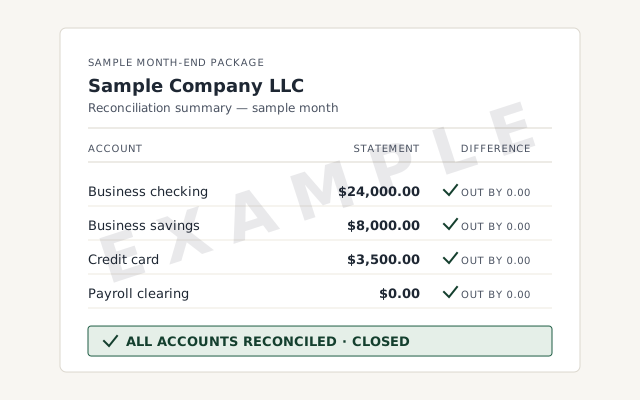 Sample workflow — not a specific client’s data
The reconciliation summary and margin-by-channel report a brewery client receives.
Agreeing recorded stock to what is physically there is the same discipline everywhere — read how we do it.
Read the inventory cleanup methodA written reply within one business day.
Remote-first, nationwide
Mon–Sat · 8am–6pm CT
We work entirely remote — view-only access for the free review, QuickBooks' accountant access for the work itself, screen-share whenever you want to watch, and every reclassified cost and agreed count recorded in writing.
TTB states that taxes on beer are determined when the product is removed from the brewery premises for consumption or sale. That is the trigger — physical removal, not the moment a customer pays. Beer sitting in the cellar carries no determined tax; the same beer moved to the taproom or loaded onto a distributor's truck does.
No, and treating it as one is the error that produces most of the damage we see. A sales tax is collected from a customer at the point of sale and remitted onward. Excise is a liability of the brewery, determined by an operational event you control, and it accrues whether or not the beer is ever sold. The two belong in different accounts and are driven by different records.
As an accrued liability tied to taxable removals, cleared when the return is paid. Because the amount is driven by quantity rather than by revenue, the entry is built from the removal records rather than from a percentage of sales. That is the whole reason a brewery's books need a quantity view sitting alongside the money view.
TTB describes the tax for a return period as being calculated on net taxable removals — removals for consumption or sale, less beer returned to the brewery during the same return period. The netting matters in practice: a keg that goes out and comes back within the period is not the same as one that went out and stayed out, and books that only record shipments will overstate the liability.
Rates, reduced rates, thresholds, filing frequencies and deadlines. Those are set by TTB, they change, and they vary with production volume. We build the structure that accrues and clears the liability correctly and we reconcile it to what you reported; the amounts and the filing calendar are matters for TTB's own guidance and your CPA. We will not state a rate as though it were ours to state.
They draw on the same underlying facts and they should agree. A brewery reports operations to TTB on a Brewer's Report of Operations and reports tax on an excise return, and both rest on the daily production and removal records. The accounting file has a third view of the same activity. When the three disagree, one of them is wrong, and finding out at audit is the expensive way to discover it.
TTB's published audit findings point at records rather than arithmetic — the most frequently cited issue is a lack of, or inaccuracy in, the records the regulations require. The specific weak points it names are beer returned to the brewery, destructions, and losses or shortages. Those are exactly the events with no invoice attached, which is why they are the ones that go unrecorded.
Brewing is manufacturing, so yes in most cases. Grain, hops and packaging are raw materials; beer in fermenters and conditioning tanks is work in process; kegs and cans ready to go are finished goods. Costs move between those stages rather than hitting expense when purchased. A file that expenses ingredients on the invoice date cannot tell you what a batch cost or what the cellar is worth.
Yes. They are different businesses sharing a brewhouse. A taproom is retail with its own margin, its own sales tax treatment and often food and merchandise alongside; wholesale to distributors or retailers moves volume at a different price with different terms. Pooled into one sales account you cannot see which channel earns, which is usually the question that prompted the call.
No. Licensing, permits, formulas, labelling, the operational reports and the excise returns themselves are yours with your CPA and your compliance advisor, and TTB's own guidance is the authority. What we own is the accounting record — the liability accrued and cleared, the inventory stages, the channel split — and making sure it reconciles to what you reported rather than contradicting it.
A brewery is a factory with a bar attached: inventory cleanup handles stock that drifted from the cellar, sales tax cleanup covers the taproom tax that excise is not, QuickBooks for restaurants has the daily-sales mechanics, and all industries lists the rest.
Not sure how bad it is?
Describe the file and a specialist will tell you which of these you are dealing with — including when the answer is that you don't need us.